


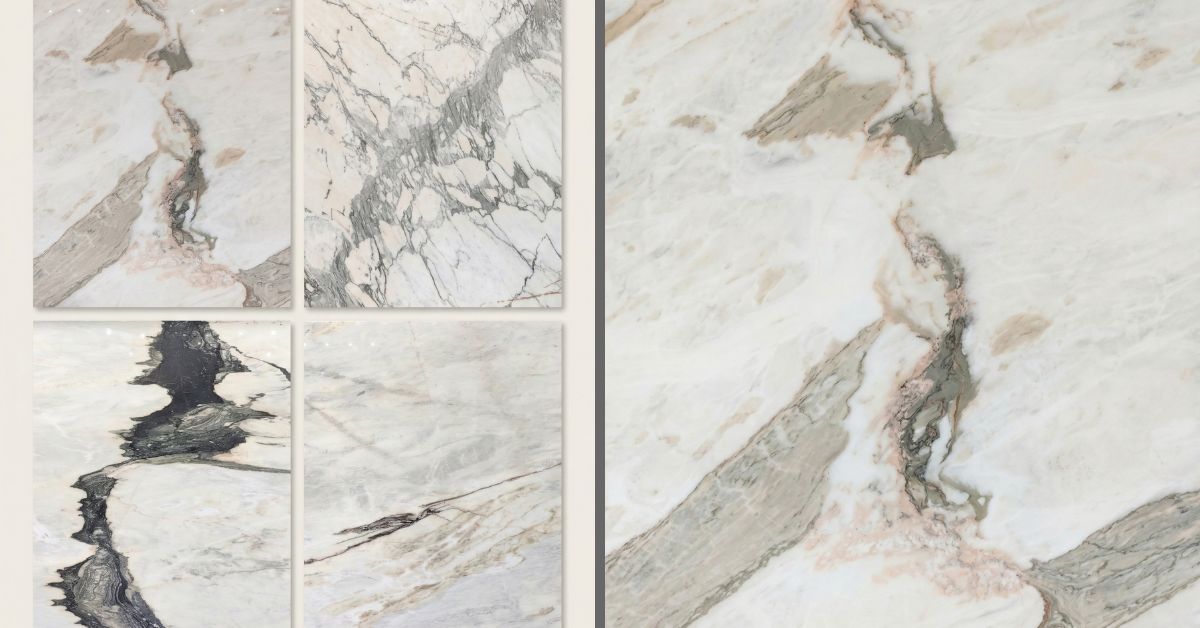
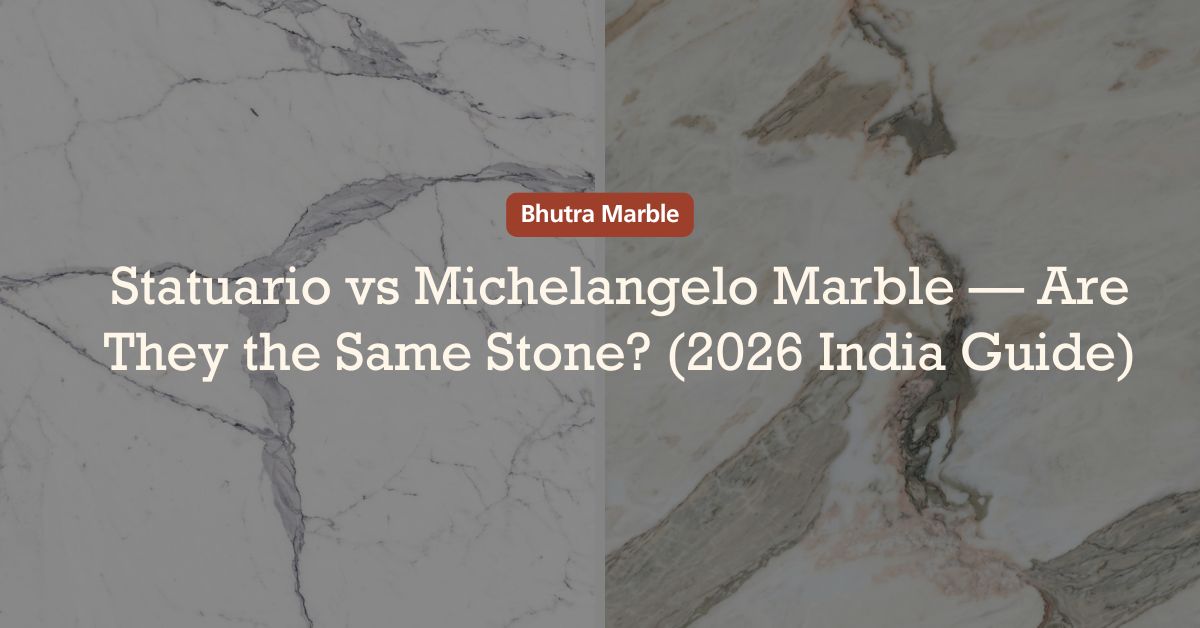
Statuario or Michelangelo marble
Quick Answer — Bhutra Marble Expert: Statuario and Michelangelo are NOT the same marble — but they come from the same quarry region in Carrara, Italy, and look very similar to the untrained eye. In India, “Michelangelo” is widely used as a trade name for premium Statuario-grade slabs with bold, dramatic veining. Genuine Statuario is rarer and more expensive (₹700–₹1,800+/sq ft), while Michelangelo-grade stone typically ranges from ₹450–₹1,200/sq ft.
The confusion matters — because some suppliers sell lower-grade white marble as “Michelangelo” and charge Statuario prices. This guide helps you tell the difference before you buy.
INTRODUCTION
Walk into any marble showroom in Kishangarh, Delhi, or Mumbai and ask for “Statuario” — you will almost certainly be shown something labelled “Michelangelo” too. The salesperson may say they are the same thing. Another may insist they are different. A third may use both names for the exact same slab.
This is the most common point of confusion in premium Italian marble buying in India — especially when buyers are trying to choose between Statuario or Michelangelo marble — and it costs real money when they do not understand the difference.
After 48 years of sourcing stone directly from Carrara quarries and supplying it to Indian homes and commercial projects, here is everything you need to know: what these names actually mean, how to visually tell them apart, what you should pay in 2026, and how to make sure you are getting exactly what you asked for.
WHAT IS STATUARIO MARBLE?
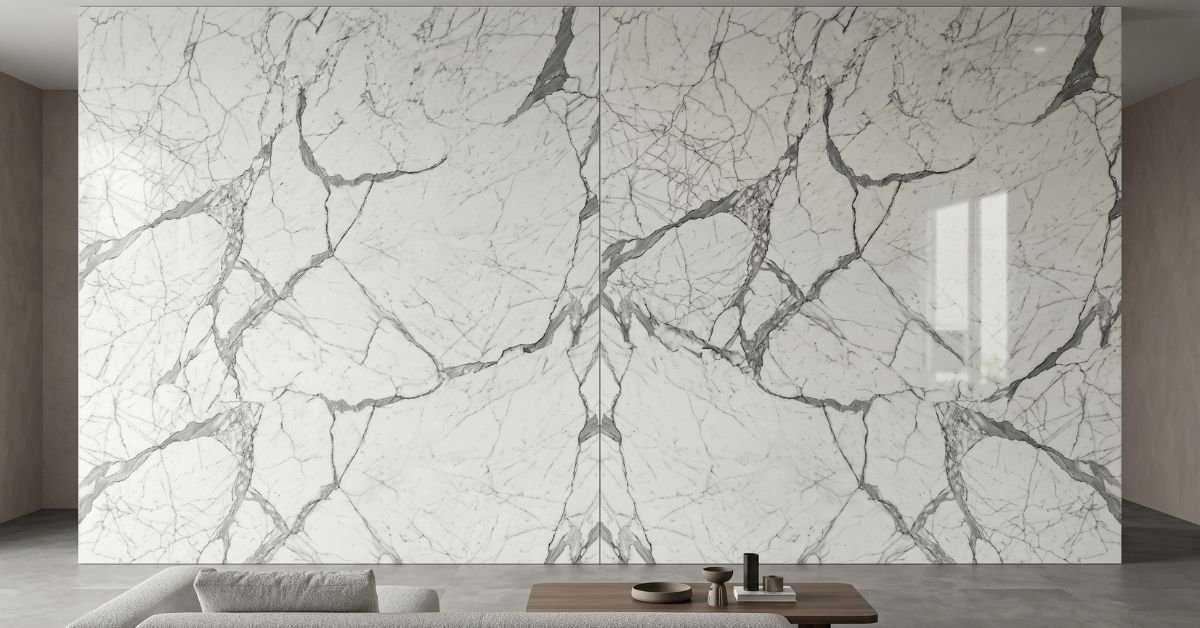
Statuario marble is one of the most prized natural stones in the world. It is quarried exclusively in the Carrara mountain range of Tuscany, Italy — the same mountains that supplied marble to Michelangelo, Bernini, and the architects of ancient Rome.
The name comes from the Latin word statuarius — meaning “of statues.” This is the marble that sculptors historically chose for fine figurative work, because it is pure white with almost no impurities, cuts cleanly, and holds detail exceptionally well.
What makes genuine Statuario distinctive:
- Pure bright white background — among the whitest of all natural marbles
- Bold, dramatic grey or gold veining with strong contrast against the white
- Translucency — holds light in a way that lower-grade white marbles do not
- Exceptional polish — achieves a near-mirror finish
- High rarity — Statuario-grade blocks are a small fraction of Carrara’s total output
Statuario is not a brand name or a marketing term. It is a grade classification recognised by Carrara quarry operators and international stone traders. Not all white marble from Carrara qualifies as Statuario.
For everything else about using Statuario marble — best rooms, finishes, installation tips, and maintenance — read our complete Statuario Marble : What It Is, Why It Commands Respect, and What Every Buyer Needs to Know →
WHAT IS MICHELANGELO MARBLE?
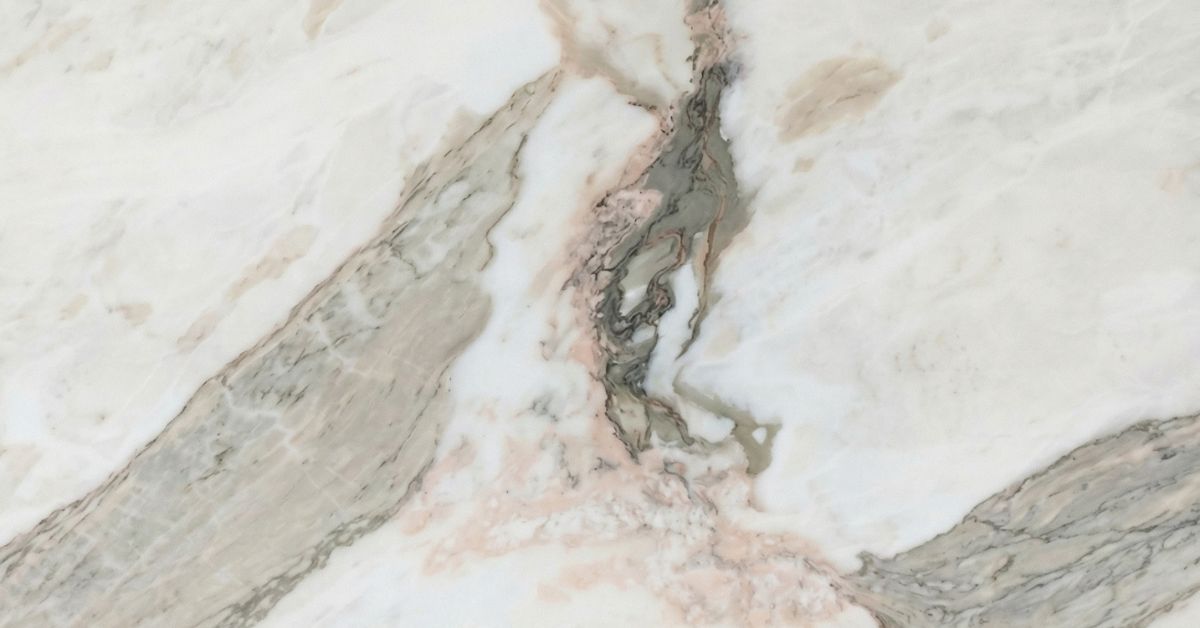
Michelangelo marble is more complex — and this is where the confusion begins for most Indian buyers.
In Italy: “Michelangelo” is not an official quarry classification. It is used informally to describe premium Statuario-grade slabs with particularly strong, bold veining — the most dramatic-looking end of the Statuario family.
In India: The name “Michelangelo” entered the Indian market decades ago as a trade name for imported Italian white marble with dramatic veining. It stuck. Today, “Michelangelo” is used across Indian stone markets to refer to three very different things:
- Genuine premium Statuario slabs with bold, dramatic veining — correctly labelled
- High-grade Italian white marble that closely resembles Statuario — a reasonable use of the name
- Lower-grade Indian or imported white marble marketed at premium prices — misleading
This is exactly why the distinction matters when you are buying in India. The word “Michelangelo” on an invoice does not guarantee the stone’s grade, quarry origin, or quality.
STATUARIO OR MICHELANGELO MARBLE — COMPLETE COMPARISON
| Feature | Statuario Marble | Michelangelo Marble (India trade name) |
|---|---|---|
| Origin | Carrara quarries, Tuscany, Italy | Carrara quarries, Tuscany, Italy |
| Official classification | Yes — recognised quarry grade | No — trade name used in India |
| Background colour | Pure bright white | Bright white (same range as Statuario) |
| Veining style | Grey or gold, bold contrast | Usually bolder and more dramatic |
| Translucency | High — light passes through slightly | High in genuine imported slabs |
| Rarity | Rare — limited quarry output | Rarer at true top-grade level |
| Price in India (May 2026) | ₹700 – ₹1,800+ per sq ft | ₹450 – ₹1,200 per sq ft |
| Risk of mislabelling in India | Moderate | Higher — name widely misused |
| Best used for | Flooring, walls, countertops | Feature walls, statement flooring, book-match |
THE HONEST TRUTH: WHY DOES THIS CONFUSION EXIST?
There are three reasons this naming confusion exists in India — and understanding them protects you as a buyer.
Reason 1 — Both come from the same quarry region. Statuario and what Indian traders call Michelangelo both originate in the Carrara mountains. At the quarry level, they are different grades of the same stone family. When a container of mixed Carrara white marble arrives at Kishangarh port, the distinction between grades is not always clearly preserved down the supply chain.
Reason 2 — Michelangelo is simply a more recognisable name in India. The name of the famous Italian artist is easier to remember and market than the technical term “Statuario.” Many Indian showrooms adopted “Michelangelo” as their primary name for premium Italian white marble 30+ years ago — and the name stuck across the entire market.
Reason 3 — There is no regulated grading standard for marble names in India. Unlike gold (hallmarked by BIS) or diamonds (graded by GIA), there is no Indian regulatory standard governing marble naming. Any supplier can label any white marble “Michelangelo” or “Statuario” without consequence. This makes buying from suppliers with transparent, direct-import sourcing especially important.
HOW TO TELL THEM APART — VISUAL IDENTIFICATION
Whether you are in a showroom or receiving samples, use these five checks before you commit:
Check 1 — Background whiteness Genuine Statuario and Michelangelo-grade stone both have a pure, bright white background — no cream tones, yellowing, or cloudy patches. Yellowing or beige undertone = lower grade white marble, not genuine Carrara premium.
Check 2 — Veining contrast Bold, high-contrast veining — grey or gold lines that stand out sharply against the white — is the signature of premium Statuario. If the veining is faint, thin, or washed out, it is not premium grade. Genuine Michelangelo-grade will have even more dramatic veining than standard Statuario.
Check 3 — Translucency test Hold a strong torch or phone flashlight behind a thin sample slab. Genuine Statuario and Michelangelo-grade stone lets light pass through slightly — you see a warm amber glow through the stone. Most lower-grade white marbles appear fully opaque.
Check 4 — Polish quality Polished Statuario achieves near-mirror finish. Run your hand flat across the surface — it should feel completely smooth with no texture. Micro-pitting, rough patches, or visible grain under polish indicates a lower grade.
Check 5 — Ask for origin documentation Reputable importers can provide the quarry name and block reference for their Statuario stock. If a supplier cannot tell you which Carrara quarry the stone came from, or cannot show import documents, that is a clear red flag.
2026 PRICE GUIDE — WHAT YOU SHOULD PAY
Prices from Bhutra Marble showroom, Kishangarh. Updated May 2026. Supply price only — installation separate.
| Stone | Grade | Price per sq ft |
|---|---|---|
| Statuario — Grade A | Bold veining, bright white background | ₹700 – ₹1,200 |
| Statuario — AAA / Bookmatched | Exhibition-grade, mirror bookmatching | ₹1,200 – ₹1,800+ |
| Michelangelo-grade (premium Statuario import) | Dramatic veining, top Carrara quarry | ₹700 – ₹1,500 |
| Indian white marble sold as “Michelangelo” | Lower grade, not Italian Carrara | ₹150 – ₹350 |
Note on the last row: Indian white marble sold under the “Michelangelo” name is a common practice in smaller showrooms and on e-commerce platforms. It is a perfectly good stone at its correct price — but it should not be charged at Italian import prices. If you are paying above ₹400/sq ft, make sure you are receiving genuine Italian stone.
2026 PRICE GUIDE — WHAT YOU SHOULD PAY
Choose AAA-grade or bookmatched Statuario if:
- You are designing a premium master bathroom, living room, or luxury lobby
- You want an investment-grade stone with a recognised name that adds resale value
- Your budget is ₹600+ per sq ft and aesthetics are the top priority
Choose Michelangelo-grade (premium Statuario with bold veining) if:
- You want the most dramatic, statement-making veining possible
- You are doing a book-matched feature wall in a hotel, office, or show home
- You want Statuario’s look with even more visual impact
Choose commercial-grade A Statuario if:
- You love the white Italian marble look but have a budget of ₹700–₹1500 per sq ft
- The space is secondary — a guest bathroom, utility area, or corridor
In all cases: Ask to see the actual full slab before committing — not a small tile sample. Marble is a natural stone and every slab varies. The slab you approve in the showroom is the slab you should receive.
For everything else about using Michelangelo marble — best rooms, finishes, installation tips, and maintenance — read our complete Michelangelo Marble Price, Uses & Buying Guide (2026) →
MAINTENANCE GUIDE: HOW TO KEEP BATHROOM MARBLE LOOKING NEW
Many homeowners avoid marble for bathrooms because of maintenance concerns — but these are easily managed with a simple routine. If you are comparing marble or granite for bathroom use, maintenance is one of the biggest factors to consider.
Sealing: Apply a penetrating stone sealer every 12–18 months. This is a 20-minute task that prevents 99% of staining issues.
Daily cleaning: Use only pH-neutral stone cleaner (avoid Harpic, bleach, vinegar, or any acidic bathroom cleaners on marble). Wipe surfaces dry after use to prevent water marks.
Stain response: If a stain occurs, do not scrub. Apply a poultice (baking soda + water paste) over the stain, cover with cling film, leave for 24 hours, then wipe clean.
Etching: If marble develops dull spots (etching from acidic substances), this can be polished out by a professional stone restorer. It is not permanent damage.
Granite maintenance: Simply clean with any mild bathroom cleaner. Reseal once every 3–5 years. No special products needed.
FAQ
Not sure which stone you are being shown? Send us a WhatsApp photo of the slab — our team will identify the grade and tell you whether the price you are being quoted is fair for what you are getting. We stock genuine imported Statuario and Michelangelo-grade marble at our Kishangarh showroom with full sourcing transparency.