
A note on who supplies what: Bhutra Marble supplies imported and Italian marble. Granite is handled by our Kishangarh group company, Stone Centre. The advice below comes from the same yard and the same fabricators — and if you need granite slabs, Stone Centre is who you’ll be speaking to.
Quick answer: For kitchen countertops, go with 18mm. For flooring laid on a full mortar bed, 16mm is usually enough and saves money. The thickness matters most where the stone is unsupported — overhangs, islands, stair treads and any span with nothing underneath it. Everywhere else, the slab’s support matters more than its millimetres.
Most “16 vs 18” articles stop at “thicker is stronger, thinner is cheaper.” That’s true and it’s useless when you’re standing in front of two quotes. Here’s the version that actually decides it.
First: What the mm on Your Quote Really Means

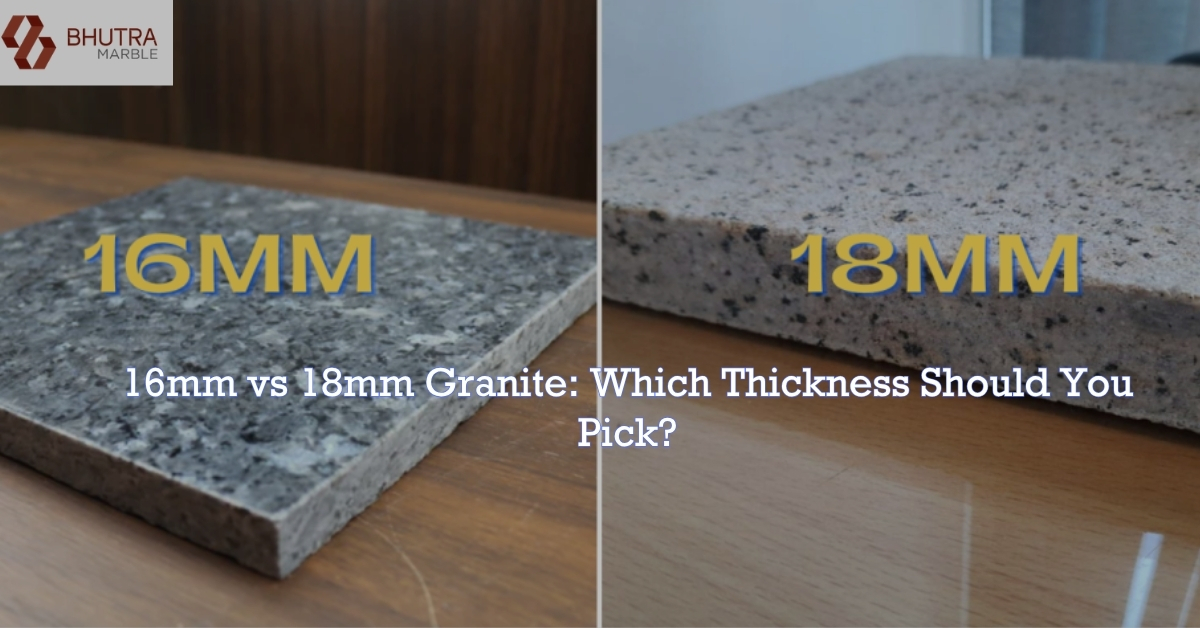
Granite in the Indian market is sold at a few standard thicknesses — roughly 15–16mm, 18mm, 20mm and 30mm — and the number on the quote is nominal, not guaranteed. A slab sold as 16mm can measure anywhere from 15mm to 17mm across its own length, because gangsaw cutting leaves variation.
Two practical consequences:
- Measure before you accept a lot. Check the thickness at four corners and in the middle with a vernier or a steel scale. A “18mm” lot that reads 16.5mm throughout is a 16mm lot being billed at 18mm rates.
- Variation within a lot creates levelling work. If thickness swings 2mm between slabs, your mason compensates in the mortar bed. That’s time and cement, and on a large floor it shows up as cost.
Ask for the thickness to be written on the invoice, not just discussed on a call.
Where the Difference Genuinely Matters

Granite doesn’t fail because it’s thin. It fails because it’s unsupported and thin. That’s the whole decision.
Kitchen countertops → 18mm (or 20mm)
A countertop carries point loads: someone leans on the edge, a heavy pressure cooker lands hard, a child sits on the overhang. The vulnerable zones are the sink cut-out and the overhang, where the slab spans with nothing underneath.
- 18mm is the Indian standard for countertops and is what most fabricators will quote by default.
- Overhangs beyond about 250–300mm need support — a steel bracket, an MS frame or a plywood sub-top — regardless of thickness. For a breakfast counter or an island seating overhang, specify this in writing with your fabricator.
- 16mm countertops are possible, usually with a plywood sub-top and an edge build-up (lamination) to make the edge look thicker. It works, but you’re adding carpentry cost to save stone cost. Do the full sum before deciding.
- Edge profiles need material to cut into. Ogee, dupont and heavy bullnose profiles want 18–20mm or a laminated edge. On a true 16mm slab your choices are basically a pencil round or an eased edge.
Flooring → 16mm is usually fine
This is where most people over-specify and spend money for nothing. Floor slabs sit on a continuous mortar bed. There is no span, so bending strength barely comes into play. A properly bedded 16mm granite floor in a home will outlast the people walking on it.
Go thicker for flooring when:
- the area takes vehicles (car porch, parking, ramps) — 20mm or more
- it’s a commercial floor with trolleys, heavy footfall or point loads
- the floor is laid over a raised or hollow substrate rather than a solid bed
Wall cladding → thinner, deliberately
For cladding, weight is the enemy. Every extra millimetre is extra dead load on the wall and extra strain on the adhesive or the fixing system. 16mm is generally the better choice for interior cladding. For exterior cladding and tall elevations, the fixing system — mechanical anchors, cramps, backing frame — matters far more than the 2mm, and that spec should come from your structural consultant, not from a thickness rule of thumb.
Stair treads, risers and thresholds
Treads span between supports and take impact at the nosing. Use 18mm or thicker for treads. Risers carry nothing and can be 16mm. Thresholds and window sills are usually 18mm so the exposed edge reads solid.
Cost: What the 2mm Actually Costs You
The slab rate difference between 16mm and 18mm is usually modest in percentage terms, and it’s rarely where your budget is decided. The things that actually move granite cost are the variety, the finish (polished, leathered, flamed, lapotra) and the quantity.
Where thickness quietly adds cost:
- Handling and breakage. Thin slabs break more in transport and during cutting. That loss sits inside somebody’s price, usually yours.
- Lamination. Building up a 16mm edge to look like a 30mm edge is skilled labour, charged per running foot.
- Sub-structure. Plywood sub-tops and steel brackets under thin countertops are a separate line item.
- Levelling. Inconsistent thickness means more mortar and more time.
A 16mm countertop with a laminated edge and a ply sub-top frequently lands at or above a plain 18mm countertop. For current granite rates by variety, see Stone Centre’s granite price list.
| Application | Recommended | Why |
|---|---|---|
| Kitchen countertop | 18mm (20mm for islands) | Point loads, sink cut-out, overhang, edge profiles |
| Breakfast counter / overhang > 300mm | 18–20mm plus bracket support | Unsupported span |
| Interior flooring (mortar bed) | 16mm | Continuous support, lower cost |
| Parking, ramps, commercial floor | 20mm+ | Vehicle and point loads |
| Interior wall cladding | 16mm | Dead load on the wall |
| Stair treads | 18mm+ | Spans and nosing impact |
| Risers, skirting | 16mm | No structural role |
| Window sills, thresholds | 18mm | Exposed edge should read solid |
What About Marble Thickness?
Different stone, different logic — and this is the part we deal with at Bhutra.
Imported and Italian marble for flooring is standard at 18–20mm. You’ll also see 12–16mm material in the market at a lower per-sq-ft rate, and it looks like a saving until you run the whole project. Thinner marble chips more at the edges during cutting, breaks more in handling, and pushes your effective wastage up — which means you buy more material to lay the same floor.
So when you compare two marble quotes, check the thickness before you compare the rate. A ₹30/sq ft gap usually isn’t a discount, it’s a different specification.
Two things worth reading before you finalise a marble order:
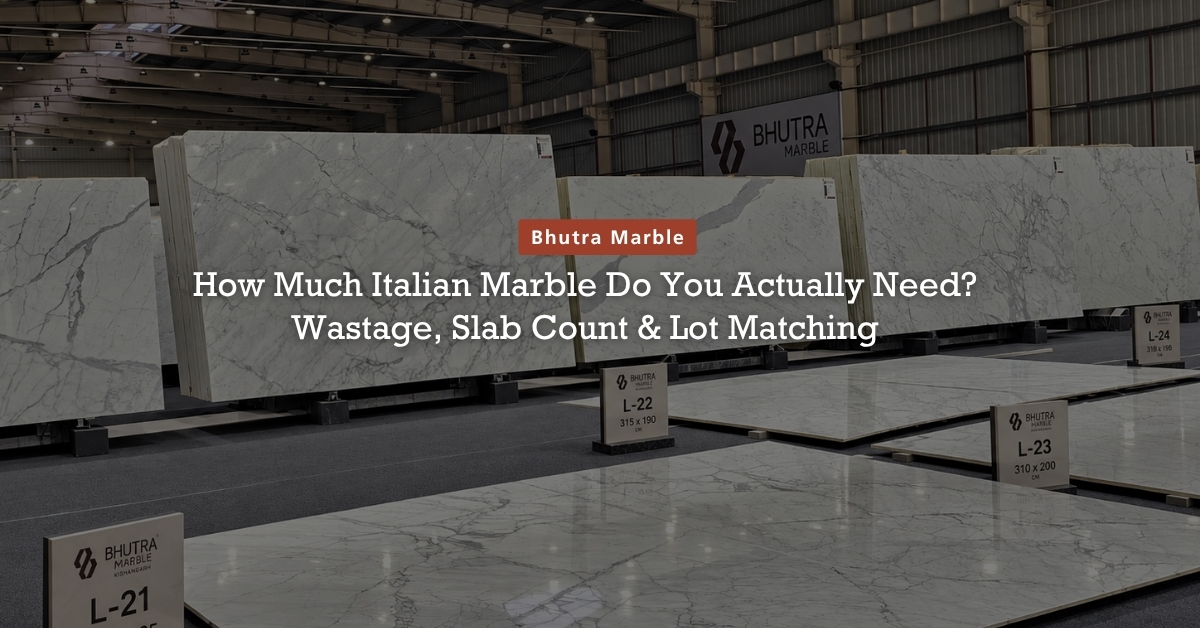
- How much Italian marble you actually need — wastage, slab count and lot matching, with a calculator
- Honed vs polished finishes — because finish changes maintenance more than thickness does
If you’re choosing between stones altogether, our guide to Italian marble in India covers the main varieties, and the Italian marble price guide has current ranges.
Five Checks Before You Approve the Lot
- Measure the thickness yourself at several points, on several slabs.
- Get the thickness onto the invoice in writing.
- Confirm who supplies the support structure for any overhang — fabricator or carpenter — before work starts.
- See the actual lot, not a sample tile. Thickness and tone both vary between lots.
- Match the thickness across the project. Floor, skirting and thresholds laid in different thicknesses create levelling problems at every junction.
The same discipline applies to marble, where we run every dispatch through our MAS inspection process before it leaves the yard.
Who to Contact
For granite — slabs, countertops, thickness options and current rates: Stone Centre, Makrana Road, RICCO Industrial Area, Kali Dungri, Kishangarh 📞 +91 91166 15702 · ✉️ info@stonecentre.in , Visit stonecentre.in →
For imported and Italian marble — Statuario, Calacatta, Carrara, Botticino and more: Bhutra Marble, KH No. 228/194, Makrana Road, Khatoli, Kishangarh, Rajasthan 305801 📞 +91 90011 56068 · ✉️ info@bhutrastones.com, Browse the marble collection → · Get a quote →
Planning a buying trip? The Kishangarh marble market guide covers how to run showroom visits without wasting a day.
Frequently asked questions (FAQ's) :-
It can be used, but it normally needs a plywood sub-top and a laminated edge to carry daily point loads and to look right. 18mm is the Indian standard for countertops and is usually the simpler, safer choice once you add up the extras a 16mm top needs.
Yes, for normal residential flooring laid on a full mortar bed. The continuous support means bending strength is barely tested. Use 20mm or thicker for parking areas, ramps and heavy commercial floors.
Granite is commonly supplied at around 15–16mm, 18mm, 20mm and 30mm. 18mm is the usual default for countertops, while 16mm is widely used for flooring and interior cladding.
Not always. Cutting variation means the real thickness can differ by a millimetre or two across the slab. Measure at several points before accepting the lot, and get the thickness written on the invoice.
The slab-rate difference is usually modest. Variety, finish and quantity move the price far more. And a 16mm countertop with a laminated edge and sub-top can end up costing the same as or more than a plain 18mm top.
16mm is generally preferred for interior cladding because it puts less dead load on the wall. For exterior and tall elevations, the fixing system matters more than the thickness, and it should be specified by a structural consultant.
Not quite. Imported marble flooring is standard at 18–20mm. Thinner 12–16mm marble is cheaper per sq ft but chips and breaks more during cutting and handling, which raises wastage and often cancels the saving.
Granite is supplied by our group company Stone Centre in Kishangarh. Bhutra Marble focuses on imported and Italian marble.
Bhutra Marble has supplied natural stone from Kishangarh, Rajasthan since 1978 — 600+ varieties, full-slab viewing at our facility, and pan-India dispatch. To view genuine Italian Statuario lots and get a fair, direct rate for delivery anywhere in India, get in touch.