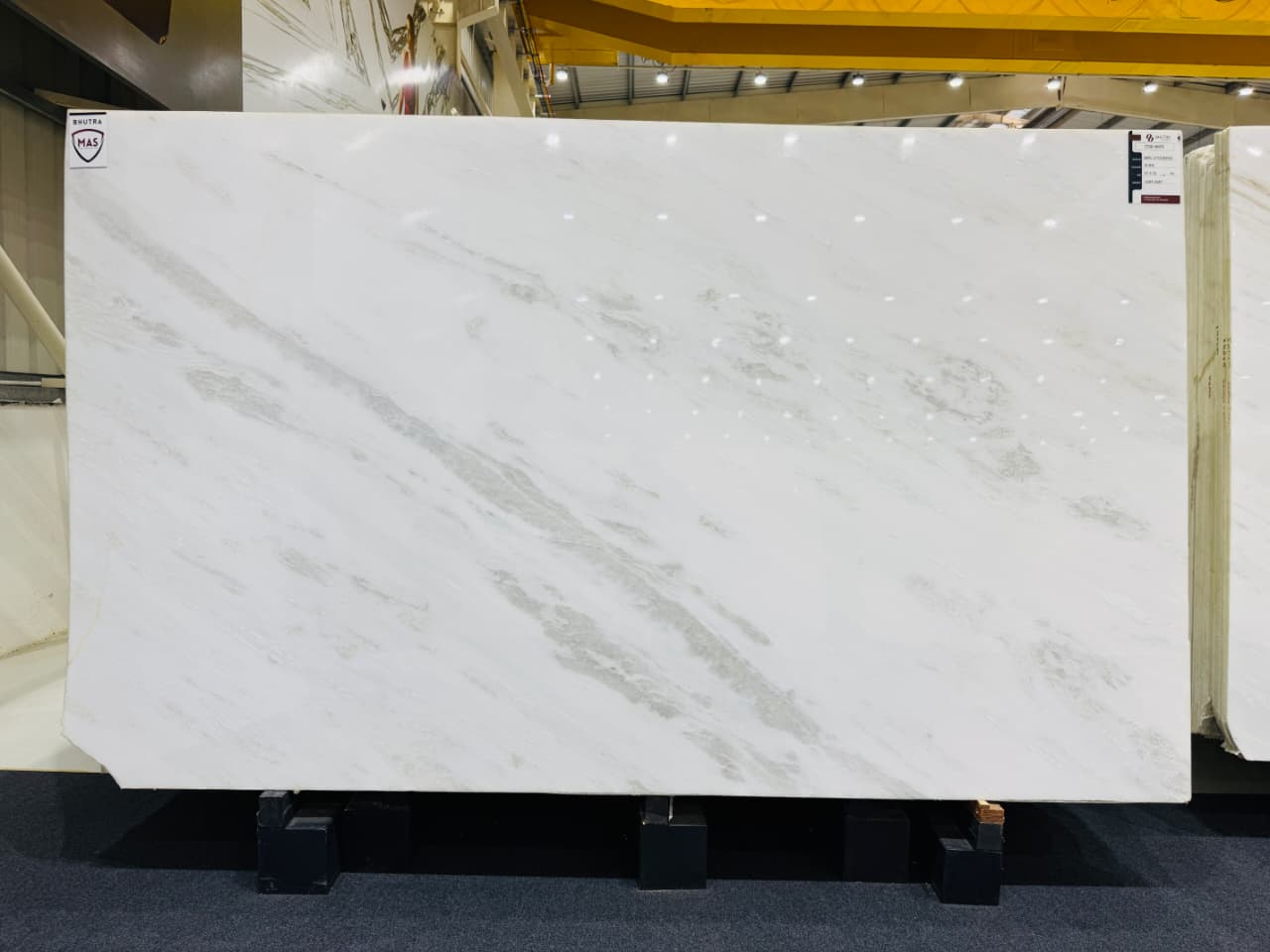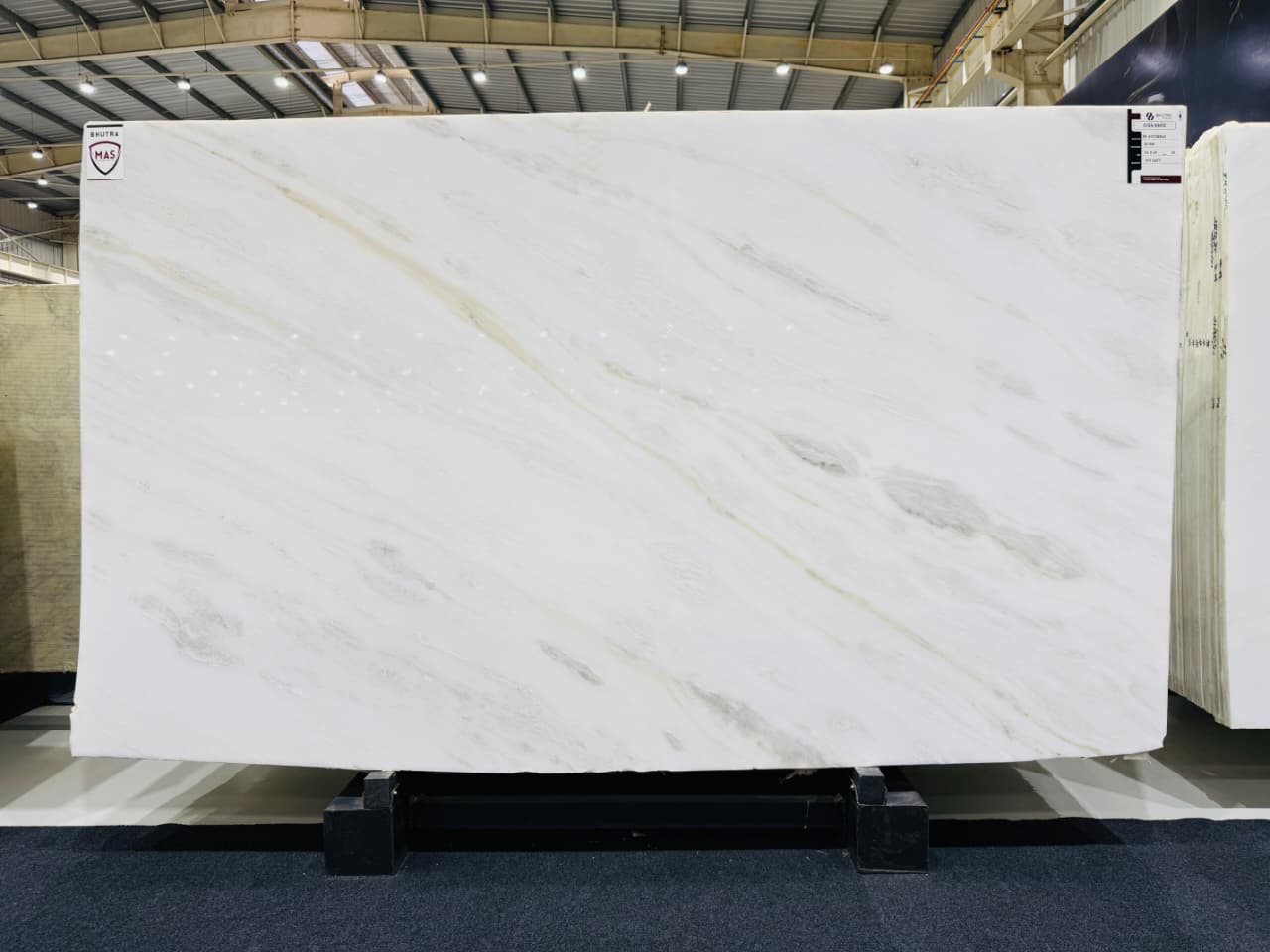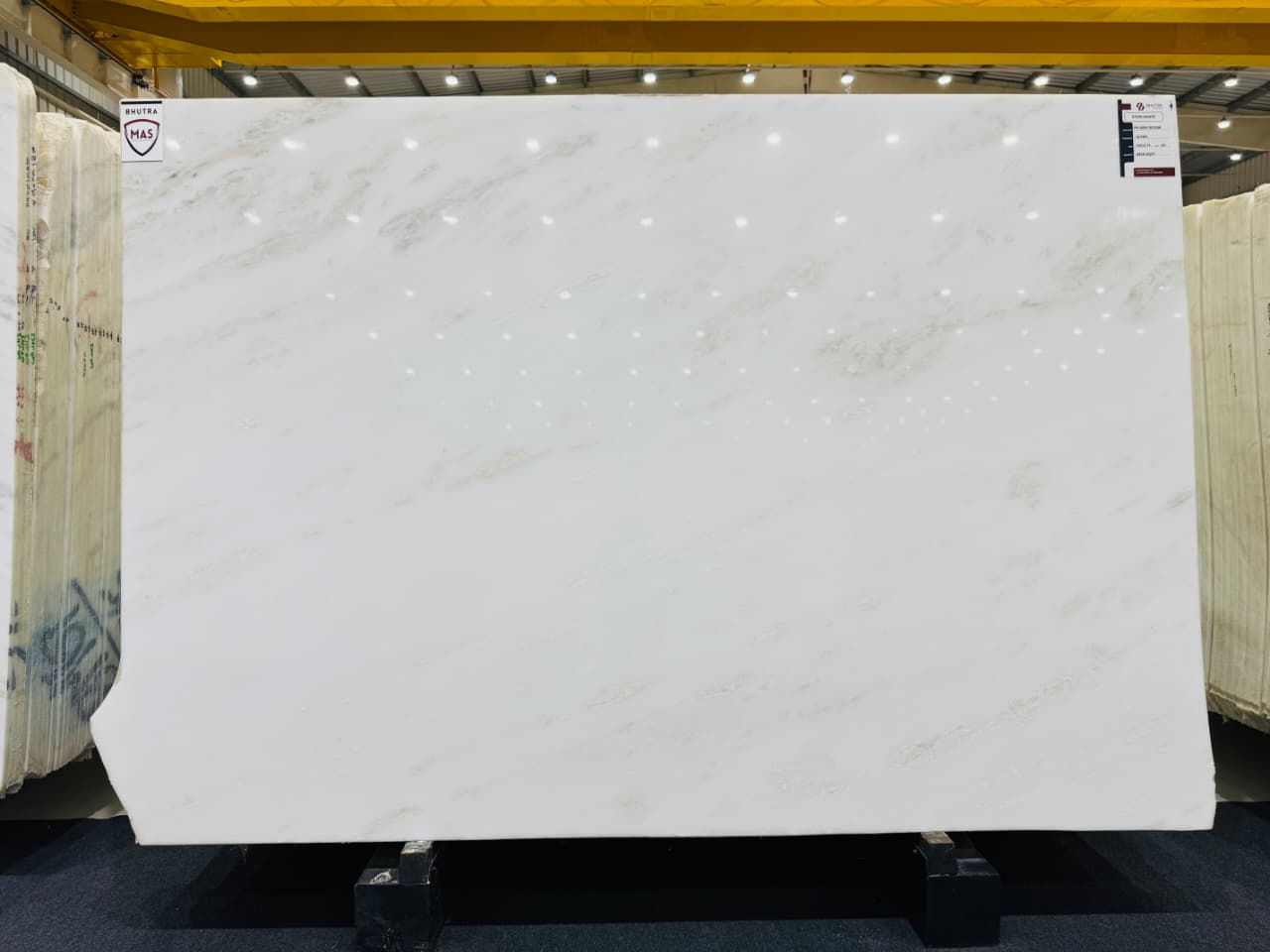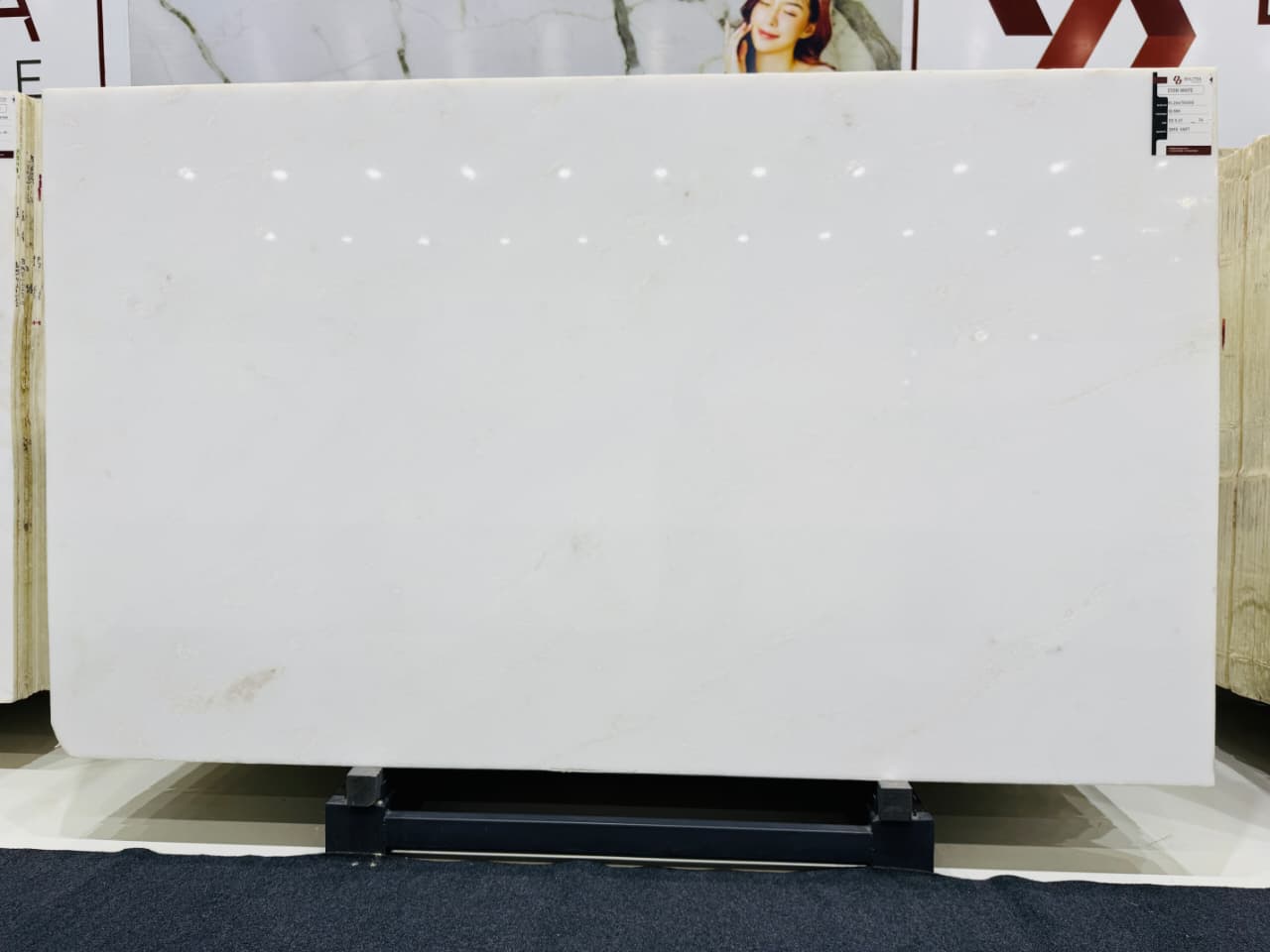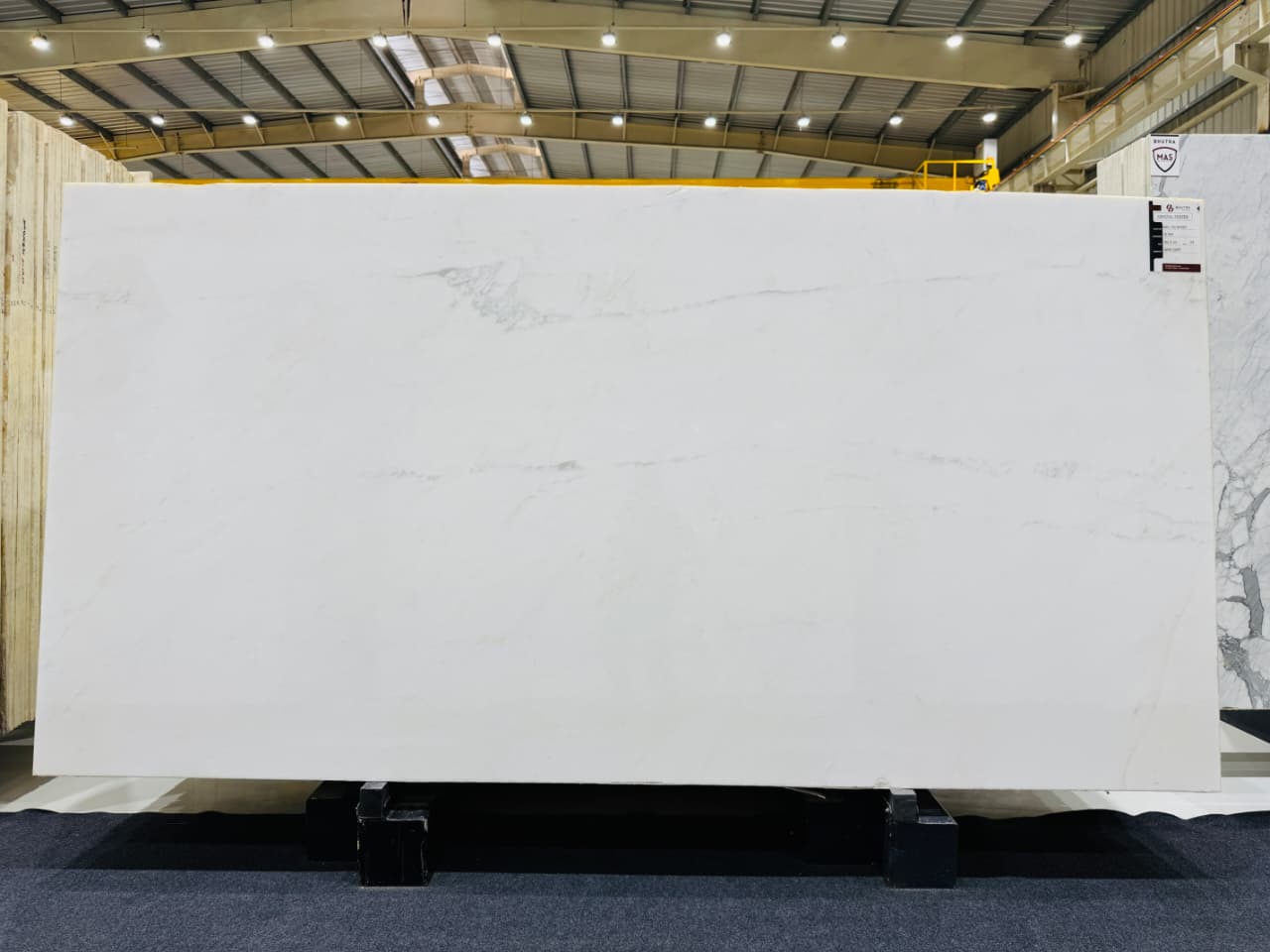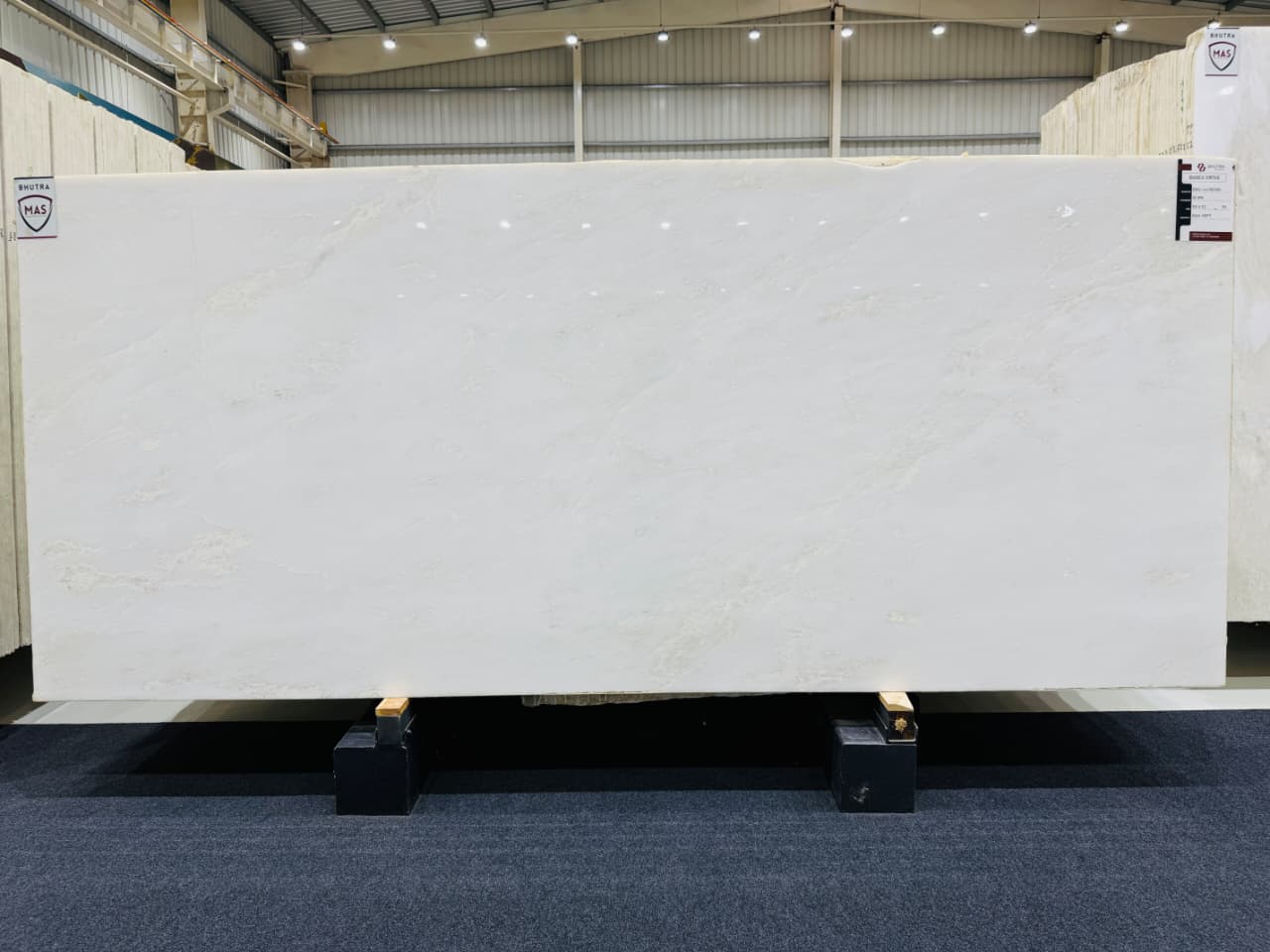


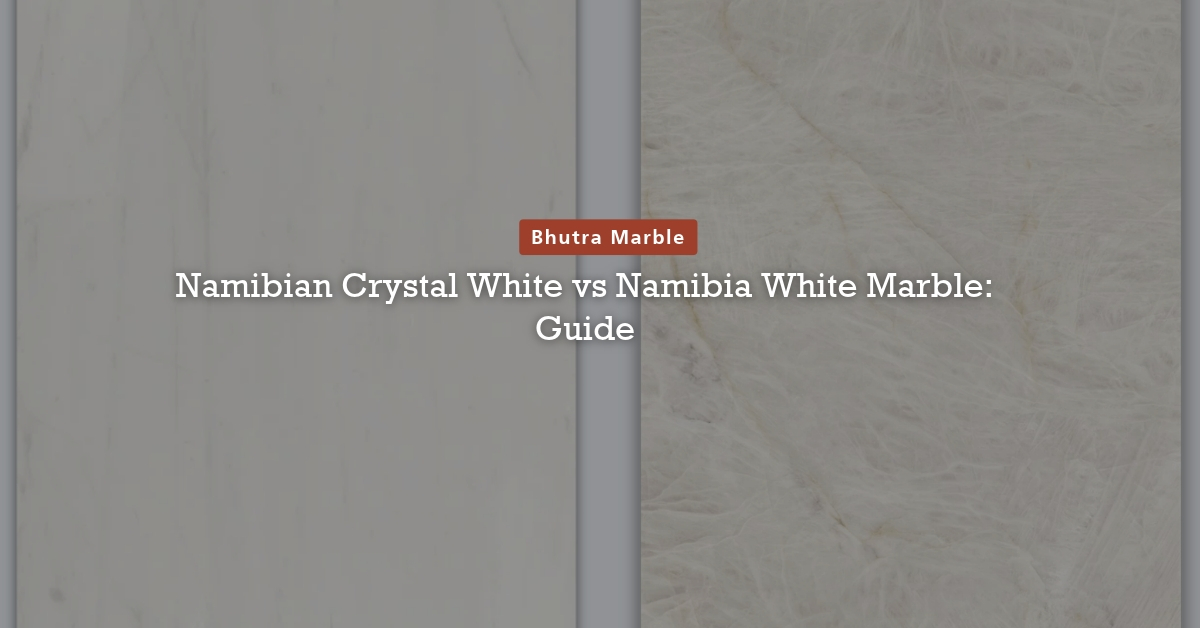
Quick answer: Namibian Crystal White, Namibia White, Namibia White Rhino, Bianco Namibia and Sugar White are trade names for the same material — a crystalline white dolomitic marble quarried near Karibib in Namibia’s Erongo region. It is a true marble, not granite and not quartzite, and it has no connection to Italy despite being sold as “Namibian white Italian marble” by some dealers. In India it typically runs around ₹600 per sq. ft. ex-Kishangarh, which places it between Vietnamese whites and Italian Statuario.
We’ve been importing and trading stone from Kishangarh since 1978, and Namibia White is one of those stones where buyers arrive genuinely confused — not about whether they like it, but about what it actually is. Five names, three wrong material categories, and a near-identical name on a completely different stone. This guide clears all of it up.
What Namibia White Marble Actually Is

It’s a dolomitic marble from the quarries around Karibib, in the Erongo region of central-western Namibia. Dolomitic means the rock is built mainly on dolomite rather than calcite, which is the technical reason it behaves differently from an Italian white in daily use — it’s a denser, harder stone.
What you see on the slab:
- A crystalline white background with a fine sugar-like sparkle under direct light
- Soft grey and ivory veining, usually restrained rather than dramatic
- A highly uniform surface — so consistent that a polished slab can read almost like white onyx at a glance
That uniformity is the whole commercial point of this stone. Where Italian whites sell on dramatic veining, Namibia White sells on calm. It’s the stone people pick when they want a white floor that doesn’t fight with the rest of the room.
The Five Names, Decoded
Every one of these refers to the same Karibib material. The name usually tells you who handled the slab before you, not what it is.
| Name you'll see | Where it comes from |
|---|---|
| Namibian Crystal White | Describes the crystalline, sugary grain of the polished surface |
| Namibia White Rhino / Rhino White | A quarry and exporter trade name |
| Bianco Namibia | The Italian-market name — slabs often route through Italian processors |
| Sugar White | Describes the fine sparkling crystal structure |
| Karibib White / Damara White | Named for the quarry town and the surrounding Damara geological belt |
Practical takeaway: ask for the origin, not the name. A supplier quoting “Rhino White” and one quoting “Bianco Namibia” may be offering the same block at two different rates. What you compare is the quarry, the lot and the grade — never the label.
What It Is Not
Three wrong categories follow this stone around, and each one costs buyers money.
It is not granite. “Namibian white granite” is one of the most common searches for this material, and it’s a category error that’s very common in India, where “granite” gets used loosely for any hard stone. Namibia White is a metamorphic carbonate rock — a marble. It will etch on contact with lemon, vinegar, tamarind or an acidic floor cleaner. Granite will not. If your contractor is treating it as granite, your maintenance plan is already wrong.
It is not quartzite. Quartzite is silica-based and considerably harder. Namibia White is carbonate-based. A slab sold to you as “Namibian white quartzite” at quartzite pricing is mislabelled, and you should ask for documentation.
It is not Italian. Some listings read “Namibia white Italian marble”. It’s quarried in Namibia. The confusion comes from the trade route — blocks are frequently shipped to Italy for cutting and finishing before reaching India, so the paperwork passes through Italy. Processed in Italy is not the same as quarried in Italy. If origin matters for your project documentation, insist on the quarry, not the port.
For how the genuine Italian whites differ, see our guide to Italian marble in India.
Namibian Crystal White vs Crystal White: Two Different Stones
This one catches people out regularly, including buyers who’ve done their homework.
Crystal White Marble on its own, without “Namibian” in front, is usually a Vietnamese stone from the Thanh Hoa and Nghe An regions. It’s calcite-based with a quartz crystalline grain. Similar sparkle, similar brightness, different continent, different rock chemistry and different price.
| Feature | Namibian Crystal White | Crystal White (Vietnamese) |
|---|---|---|
| Origin | Karibib, Namibia | Thanh Hoa / Nghe An, Vietnam |
| Rock type | Dolomitic marble | Calcite marble with quartz grain |
| Veining | Soft grey and ivory | Minimal, near-uniform |
| Typical use | Flooring, counters, stairs | Flooring, backlit panels, mandir |
Both are good stones. They are not substitutes, and they shouldn’t be quoted against each other. If you’re weighing them, compare the actual slabs: Namibia White and Crystal White.
A related note: Dover White, also sold as Oyster White, is likewise quarried in Namibia but is marketed as its own material with a greyer, more linear character. You can see it here.
How to Identify Genuine Namibia White
Five checks, in the order we’d run them on the yard floor.
- Look at the grain in direct light. Genuine Namibia White has a visible fine crystalline sparkle — the “sugar” texture the trade name refers to. A flat, dead-white surface with no grain is usually a different stone or an engineered product.
- Check vein behaviour across the full slab. The veining is soft, grey-to-ivory and restrained. Bold, high-contrast grey veining running in defined strokes means you’re looking at an Italian white, not this.
- Ask for origin documentation. An importer should be able to show import papers for the lot naming Namibia. This is the single check that settles it.
- Test the edge, not the face. Ask to see a cut edge. The crystalline structure should carry through the thickness, not sit only on a polished surface.
- Be suspicious of a rate far below market. Namibia White is imported from a limited set of quarries with moderate output. A quote well under the going range usually means a Vietnamese or Indian white being sold under the Namibian name.
Every slab we dispatch runs through our MAS inspection process before it leaves the yard, and we share lot photographs before despatch.
How It Compares to the Other White Marbles
| Stone | Origin | Character | Best suited to |
|---|---|---|---|
| Namibia White | Namibia | Crystalline white, soft grey-ivory veins, very uniform, dense | Large floors, counters, stairs — where calm and durability matter |
| Thassos | Greece | Pure white, essentially vein-free, bright | Statement areas, bathrooms, where absolute white is wanted |
| Statuario | Italy | Bright white, bold defined grey veining | Focal floors and feature walls meant to be noticed |
| Vietnam White / Crystal White | Vietnam | Clean white, minimal movement | Budget-conscious large areas, backlit panels, mandir |
| Makrana | India | Warm white, dense, GI-tagged | Temple work, pooja rooms, carving, long-life floors |

Where Namibia White earns its place: it’s the uniform option that is also hard-wearing. Thassos is brighter but far less forgiving on a busy floor. Statuario is more dramatic and several times the price. Vietnamese whites cost less but don’t match the density.
Choosing more broadly? Our comparison of the best marble types for Indian floors puts these side by side, and the imported white marble guide covers the full imported range.
Which Finish Should You Choose?
Polished brings out the crystalline sparkle and reads brightest. It’s the right call for living rooms, formal areas and anywhere the stone is meant to reflect light. It also shows etch marks most clearly.
Honed gives a soft matte surface, hides etching and light scratching far better, and offers more grip underfoot. Use it in bathrooms, kitchens, around pools and on stair treads.
The practical rule we give buyers: polished where it’s seen, honed where it’s used wet. Our guide to honed vs polished finishes goes deeper.
Is It Suitable for Kitchen Countertops?
Better than most white marbles, but go in with clear eyes.
Its dolomitic structure makes it denser and more scratch-resistant than a typical calcite-based Italian white. That’s a real advantage on a working counter.
It is still a carbonate stone, which means acid etching remains possible. In an Indian kitchen — lemon, tamarind, tomato, vinegar — etching is the risk to plan for, not staining. What helps:
- Choose a honed finish so etch marks don’t stand out against a gloss
- Seal on installation and reseal periodically
- Wipe acidic spills immediately rather than at the end of cooking
- Use only pH-neutral cleaners — most Indian floor cleaners are acidic and made for ceramic tiles
If your kitchen sees heavy daily cooking and nobody will be wiping spills promptly, use it on the island or backsplash and put a harder material on the main work counter.
What It Costs, and What Moves the Price
Namibia White sits in the upper-middle of the imported white range in India — above Vietnamese whites, well below Statuario and Calacatta. Current rates and availability are on the Namibia White Marble slab page.
Four things move the number:
- Grade and lot — background consistency and vein restraint. Cleaner, more uniform lots cost more.
- Thickness — 18 mm and 20 mm are standard; 20 mm is the usual choice for flooring and counters.
- Finish — polished, honed, and special finishes each carry different processing cost.
- Quantity and lot availability — Namibian quarries run at moderate output in mostly medium-sized blocks, so large single-lot requirements are not always available on demand.
That last point matters more here than with most stones. Before you commit to a large floor, check our guide on how much marble to actually order — with a moderate-output quarry, a top-up lot weeks later is unlikely to match. For a wider view of rates across stones, see the marble price guide for India.
Where to Buy Namibia White Marble in India
Namibia White is an imported stone, so it reaches India through importers rather than domestic quarry traders. Kishangarh, Rajasthan is where most of the country’s imported stone lands and is processed, which is why buyers from Delhi, Mumbai, Bengaluru and Hyderabad source from here rather than through a local dealer who is buying from Kishangarh anyway.
What to ask any supplier before you commit:
- Import documentation naming Namibia as the origin
- Full-slab viewing, not a sample tile — uniform stones show their variation at scale
- Available lot size in sq ft against your requirement
- Thickness and finish confirmed in writing on the invoice
- Crating, insurance and despatch photographs
At Bhutra Marble we’ve traded stone from Kishangarh since 1978 and carry 650+ varieties, with full-slab viewing at the showroom and crated, insured despatch across India. You can select slabs over live video if you can’t travel.
📍 KH No. 228/194, Makrana Road, Khatoli, Kishangarh, Rajasthan 305801 📞 +91 90011 56068 · ✉️ info@bhutrastones.com
See Namibia White slabs and current rates → · Request a quote →
Planning a buying trip? Read the Kishangarh white marble guide first so a showroom day doesn’t get wasted.
Frequently asked questions (FAQ's) :-
Yes. Namibian Crystal White, Namibia White, Namibia White Rhino, Bianco Namibia and Sugar White are all trade names for the same crystalline dolomitic marble quarried near Karibib in Namibia. The name usually reflects which exporter or processor handled the slab, not a difference in the stone.
It is a marble. "Namibian white granite" is a common mislabelling, particularly in India where granite is used loosely for any hard stone. Because it is a carbonate rock, it can etch from acids such as lemon, vinegar and tamarind, which granite does not.
No. It is quarried in Namibia. Blocks are often shipped to Italy for cutting and finishing before reaching India, which is where the "Namibian white Italian marble" label comes from. Processed in Italy is not the same as quarried in Italy.
Near the town of Karibib in the Erongo region of central-western Namibia, in southern Africa. The quarries have moderate output and supply mostly medium-sized blocks.
Crystal White on its own usually refers to a Vietnamese marble from the Thanh Hoa and Nghe An regions — calcite-based with a quartz crystalline grain. Namibian Crystal White is the Namibian dolomitic marble. The names are close but the stones are different in origin, chemistry and price.
Look for the fine crystalline sparkle in direct light, soft grey-to-ivory veining rather than bold strokes, and a crystalline structure visible on the cut edge. Ask the importer for documentation naming Namibia, and be cautious of rates well below the market range.
It is more scratch-resistant than most calcite-based white marbles because of its dolomitic structure, but it can still etch from acidic foods. Choose a honed finish, seal it on installation and wipe acidic spills promptly.
Polished brings out the crystalline sparkle and suits living areas and formal spaces. Honed hides etching and offers better grip, making it the better choice for bathrooms, kitchens and stair treads.
Thassos is a Greek marble that is brighter and essentially vein-free, which makes it a stronger statement stone but less forgiving on a busy floor. Namibia White has soft grey-ivory veining and a denser, more hard-wearing structure, which suits large flooring areas better.
Bhutra Marble has supplied natural stone from Kishangarh, Rajasthan since 1978 — 600+ varieties, full-slab viewing at our facility, and pan-India dispatch. To view genuine Italian Statuario lots and get a fair, direct rate for delivery anywhere in India, get in touch.