


Quick answer: Botticino marble is a warm beige Italian stone quarried around the town of Botticino, near Brescia in northern Italy. It comes in four main commercial types: Classico, Semiclassico, Fiorito and Crema. In India, Botticino marble price usually falls around ₹250–₹500 per sq ft ex-Kishangarh for standard 18mm polished slabs depending on type and grade. It’s one of the most practical imported marbles for flooring because the beige tone hides dust and daily wear far better than white marble.
We’ve been trading natural stone from Kishangarh since 1978. Botticino is one of those stones buyers come in asking about by name, usually after seeing it in a hotel lobby or a friend’s villa. Then they get to the yard and realise there isn’t one “Botticino.” There are several, and the price and the look change with each.
This guide is what we tell those buyers across the counter.
What Is Botticino Marble?
Botticino marble is named after Botticino, a small town in the province of Brescia in Lombardy, northern Italy. The stone has been quarried in that area for centuries. The most famous building made from it is the Vittoriano (Altare della Patria) in Rome, the huge white-beige monument you see in almost every photo of the city.
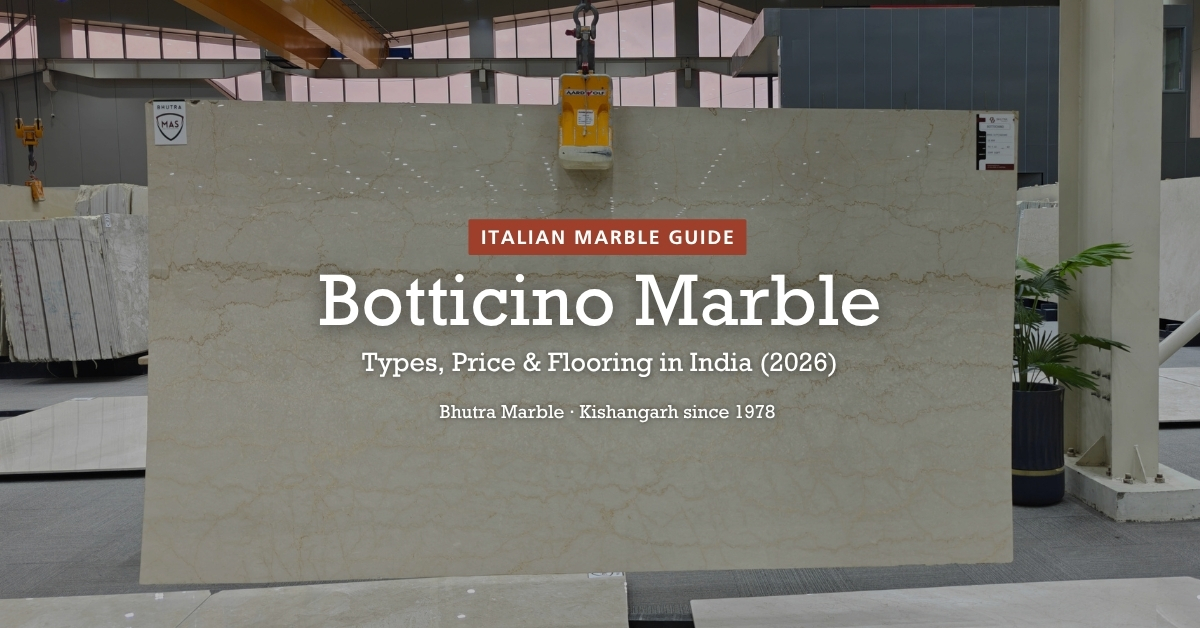
Geologically, Botticino is a very fine-grained limestone that the stone trade sells as marble. That fine grain is what gives it such a smooth, even surface. It’s compact, with low water absorption compared to many beige stones, which is part of why it has lasted so long in heavy-use public buildings.
What you see on the slab:
- A cream to light-beige background
- Thin, wandering brown or golden veins, sometimes looking like fine cracks
- Small fossil flecks and cloudy patches, which are natural and a sign of the real stone
If you’re comparing it with other warm stones, our beige Italian marble guide covers the wider family.
Types of Botticino Marble
This is where most buyers get confused, and where some sellers take advantage of that confusion. The name on the invoice matters.
| Type | Look | Where it works best |
|---|---|---|
| Classico | The benchmark. Even cream-beige base with fine brown veining | Flooring, staircases, wall cladding, lobbies |
| Semiclassico | Similar base, veins less defined, a little more variation in tone | Large flooring areas where budget matters |
| Fiorito | Beige with light, cloudy "flower-like" patches (fiorito means flowered). Considered the toughest of the group | Heavy-traffic floors, exteriors, paving |
| Crema | Warmer, creamier tone with softer movement | Bedrooms, bathrooms, calm luxury interiors |
A bit more on each:
Classico is what most architects mean when they write “Botticino” in a drawing. It’s the most consistent, which makes it easier to match across a big floor. See our Botticino Classico slabs for current stock.
Semiclassico comes from the same belt of quarries but with less defined veining. For a large hall or a commercial floor, it can give you the Botticino look at a friendlier rate. Here are our Semiclassico slabs.
Fiorito is the one people either love or skip. Those white clouds give it a softer, almost textured character. It’s quarried around Nuvolera, also in Brescia, and it’s the variety we suggest when a client wants beige marble for an outdoor area or a very busy floor. Browse Fiorito stock here.
Crema leans warmer and creamier. In a bedroom with warm lighting it looks lovely, almost like soft butter. Check Crema availability.
There’s also a darker, browner grade the Italian trade calls Botticino Extra. It rarely comes into India in volume, but if you want it, ask us.
Botticino Marble Price in India (2026)
Here’s how pricing usually looks at our Kishangarh yard. These are indicative starting rates for 18mm polished material. Actual rates move with slab grade, lot size, thickness and finish.
| Type | Indicative price (₹ per sq ft) |
|---|---|
| Botticino Classico | ₹275 onwards |
| Botticino Semiclassico | ₹250 onwards |
| Botticino Fiorito | ₹260 onwards |
| Botticino Crema | ₹270 onwards |
What actually moves the price:
- Grade. Slabs with an even background and few cloudy patches cost more. Heavy fossil zones or colour shifts sit lower.
- Slab size. Large, full slabs mean fewer joints on the floor, and they’re priced higher than cut tiles.
- Finish. Polished, honed and brushed are all available. Special finishes add processing cost.
- Thickness. 18mm is standard for flooring. 20mm and above costs more.
- Freight. Delivery to Mumbai, Delhi or Bengaluru adds transport and crating on top of the ex-Kishangarh rate.
Budget roughly ₹50–₹150 per sq ft extra for installation, grinding and final polish, depending on your contractor and city.
For a wider comparison with other stones, see our full Italian marble price guide or the all-types marble price list for India.
Want today’s rate? WhatsApp us at +91 90011 56068 with your area in sq ft and city. We’ll send live slab photos with lot sizes.
Botticino Marble Flooring: Is It a Good Choice?

Short answer: yes, it’s one of the best beige options for Indian homes. A few honest reasons.
It forgives daily life. White marble shows every footprint, dust line and tea stain. A Botticino floor hides most of that. For a family home with kids, parents and a lot of walking around, this matters more than people expect.
It makes rooms feel warmer. Under warm LED lighting, Botticino glows a soft cream. Under daylight it reads more neutral. Either way it never feels cold like grey stone can.
It works with wood and brass. Teak furniture, brass fittings and cane or rattan all sit comfortably on a Botticino floor. That’s why it shows up so often in traditional and “modern Indian” interiors.
It handles traffic. Its compact structure holds up well in lobbies, living rooms and corridors. For the very busiest areas, Fiorito is the stronger pick.
A few flooring tips from what we see on site:
- Buy all your flooring from one lot. Beige tones shift between lots, and mixing them shows.
- Lay out the slabs before fixing. Put the cloudier pieces in bedrooms or under furniture, and keep the cleanest ones for the main hall.
- Go honed in areas that get wet. Polished Botticino can be slippery with water on it.
If you’re still deciding between stones, our comparison of the best marble types for Indian floors puts Botticino next to Katni, Makrana and others.
Botticino Marble in Bathrooms, Kitchens and Walls
Bathrooms. Botticino works well on bathroom walls and vanities. The beige hides water marks better than white. Use a honed finish on the floor and seal everything properly.
Kitchen countertops. It can be used, but go in with open eyes. Like all calcite stones, Botticino can etch from lemon, vinegar, tomato and tamarind. If your kitchen sees heavy Indian cooking, consider it for the backsplash or island, and keep the main work counter in something harder.
Wall cladding and staircases. This is where Botticino looks its best. Stair treads in Classico, with a matching skirting, are a classic combination we still recommend.
Not sure whether to go polished or matte? Read honed vs polished finishes before you finalise.
Botticino Marble Texture: What to Expect on the Slab

People searching “botticino marble texture” usually want to know what the real stone looks like up close. Three things:
- Fine veins, often called “hairline” veins, running in random directions
- Fossil flecks, tiny darker or lighter spots from ancient marine life trapped in the limestone
- Clouds, soft lighter patches, strongest in Fiorito
On a polished slab, all of this sits under a gentle gloss. On honed, the texture looks softer and more matte.
Is there a “white Botticino”? Not really. Some lots of Classico are very light, almost ivory, and get sold as white Botticino. But it’s still a beige-family stone. If you truly want a white floor, look at our white marble collection instead.
Botticino vs Crema Marfil
These two get compared all the time because both are warm beige.
| Botticino | Crema Marfil | |
|---|---|---|
| Origin | Italy (Brescia) | Spain |
| Background | Cream to light beige | Ivory to warm beige |
| Veining | Fine brown hairline veins, fossil flecks | Softer, more uniform, fewer visible veins |
| Feel | Classic, slightly textured | Calm, clean, more uniform |
| Good for | Floors, stairs, cladding, exteriors (Fiorito) | Bathrooms, interior floors, counters |
In India, Crema Marfil is often sold under the “Italian marble” label even though it’s Spanish. It’s a good stone. Just know what you’re buying if origin matters for your project.
How to Make Sure You're Getting Genuine Botticino
The name “Botticino” is valuable, so it gets borrowed. Beige limestones from other countries are sometimes sold under Botticino-style names at Italian prices. Here’s how to protect yourself:
- Ask for origin paperwork. An importer should be able to show import documents for the lot.
- See the full slab, not a small tile. Real Botticino has its fossil flecks and hairline veins spread naturally across the slab.
- Check the tone across the whole lot. Genuine lots have natural variation, but a good supplier sorts slabs so your floor stays consistent.
- Compare two types side by side. Classico next to Semiclassico or Fiorito quickly shows you what you’re paying for.
- Be careful with prices that look too good. If a “Classico” rate is far below the market, ask what the stone actually is.
Every slab we dispatch goes through our MAS (Marble Augmentation System) process before it leaves the yard.
How to Maintain Botticino Marble
- Seal after installation, and reseal every 1–2 years in kitchens and bathrooms
- Clean with a pH-neutral stone cleaner and a soft mop
- Avoid acid-based floor cleaners, vinegar and lemon
- Wipe spills of chai, juice or curry quickly
- Put felt pads under furniture legs
- Get a machine polish every few years to bring back the shine.
Is Botticino Marble Good? Our Honest Take
For most Indian homes, yes. It looks rich without being loud, it’s easy to live with, and it costs noticeably less than showpiece whites like Statuario or Calacatta. It’s the stone we recommend when a client wants imported marble but also wants a floor that still looks good ten years later.
It’s not the right pick if you want a bright white look, or a kitchen counter that shrugs off lemon juice. For everything else, it’s hard to go wrong.
If you want to understand how it fits into the wider imported range, our guide to Italian marble in India explains the main families.
See Botticino Slabs at Our Kishangarh Showroom

Photos never show beige marble properly. Tone, clouds and veins all change in real light. The best way to choose is to walk through full slabs of Classico, Semiclassico, Fiorito and Crema side by side.
📍 Bhutra Marble — KH No. 228, 194, Makrana Road, Khatoli, Kishangarh, Rajasthan 305801 📞 Call / WhatsApp: +91 90011 56068 ✉️ Email: info@bhutrastones.com
Explore our full Botticino marble range → | Get a quote →
We deliver crated and insured across India, including Mumbai, Delhi NCR, Bengaluru and Hyderabad.
Frequently asked questions (FAQ's) :-
Botticino marble is a beige Italian stone quarried near the town of Botticino in Brescia, northern Italy. It has a cream to light-beige background with fine brown veins and small fossil flecks, and it's widely used for flooring, staircases and wall cladding.
Botticino marble usually costs around ₹250–₹500 per sq ft ex-Kishangarh for standard 18mm polished slabs. The exact rate depends on the type (Classico, Semiclassico, Fiorito or Crema), slab grade, thickness and finish.
Yes. Botticino is one of the most practical imported marbles for Indian floors because its beige tone hides dust and daily wear. Use a honed finish in wet areas, and buy the full requirement from one lot so the tone matches.
Classico has an even cream-beige base with fine brown veining and is the most consistent grade. Fiorito has light, cloud-like patches and is considered the toughest Botticino type, which makes it a good choice for heavy-traffic floors and exteriors.
Not strictly. Some very light Classico lots are sold as "white Botticino," but the stone is part of the beige family. For a true white look, choose a white marble such as Statuario or Carrara.
Botticino is Italian and shows fine brown hairline veins and fossil flecks. Crema Marfil is Spanish and has a more uniform ivory-beige tone with softer veining. Both are used for floors, but Botticino has a more classic, textured look.
It works well in bathrooms when sealed and honed on the floor. In kitchens, it can etch from acidic foods like lemon and tamarind, so it's better suited to backsplashes and islands than to heavy-use cooking counters.
Bhutra Marble has supplied natural stone from Kishangarh, Rajasthan since 1978 — 600+ varieties, full-slab viewing at our facility, and pan-India dispatch. To view genuine Italian Statuario lots and get a fair, direct rate for delivery anywhere in India, get in touch.