


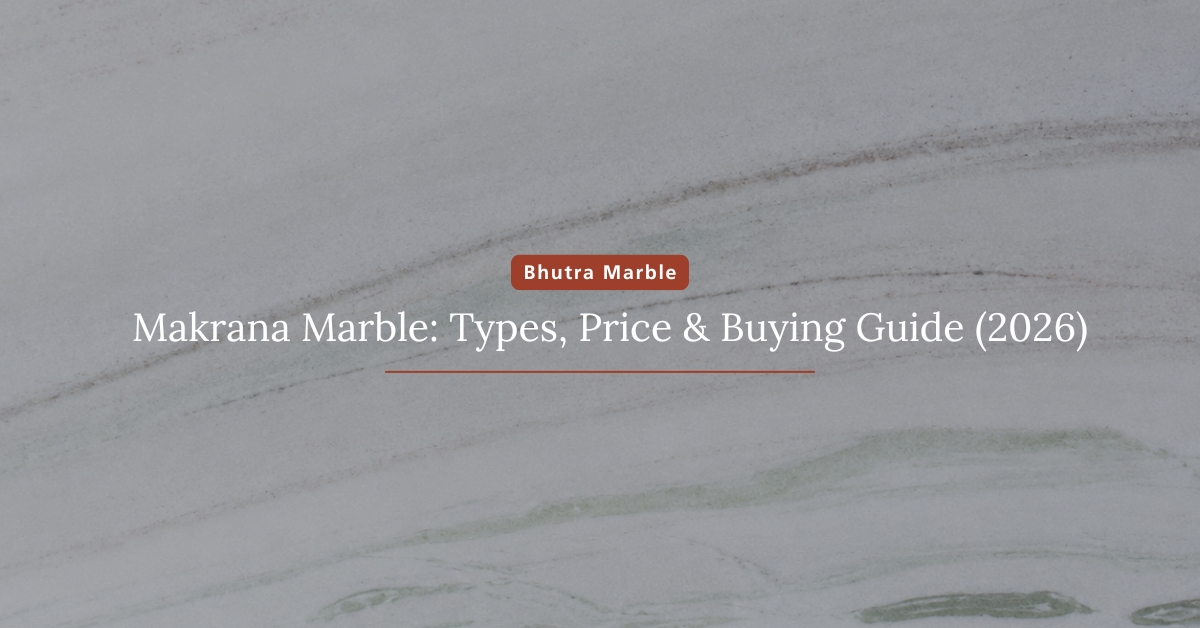
Makrana marble price in 2026 ranges from ₹90 to ₹650 per sq ft ex-Kishangarh, depending on variety. Commercial-grade Kumari costs ₹90–₹160, premium Albeta ₹250–₹450, and top-grade Dungri ₹350–₹650 per sq ft. Carving and statue-grade Dungri goes from ₹700 upward.
Makrana is quarried in Nagaur district, Rajasthan, and is the only Indian marble with a GI tag (2015). It is roughly 98% calcite, does not yellow with age, and was used in the Taj Mahal, the Victoria Memorial and the Ram Mandir at Ayodhya.
The six varieties you’ll be offered: Dungri (purest, statue grade) · Albeta (classic veined white) · Chak Dungri · Ulodi (grey veining) · Kumari (best value) · Pink Makrana.
Quickest authenticity check: ask which mine the stone came from, and pour water on the unpolished back — genuine Makrana absorbs slowly and dries fast.
Add ₹8–₹15/sq ft freight to Jaipur, ₹20–₹35 to Delhi NCR, ₹45–₹70 to Kolkata.
Walk into any marble market in North India and ask for “white marble.” You’ll be shown twenty slabs. Ask specifically for Makrana, and the conversation changes — the tone gets more careful, the prices jump, and somebody will almost certainly bring up the Taj Mahal within the first minute.
That reaction isn’t marketing. Makrana is the only Indian marble with a Geographical Indication tag, and it’s one of a very small group of stones worldwide recognised by the International Union of Geological Sciences as a Global Heritage Stone Resource. Nearly 400 years after Shah Jahan’s masons started cutting it, the same mines are still producing.
But heritage is exactly why buying it has become complicated. “Makrana” gets used loosely in the trade, and a lot of white stone sold under that name never came near Nagaur district. So this guide covers what you actually need: the real varieties, honest 2026 pricing, how to check authenticity, and where it makes sense to use.
We’ve been trading natural stone out of Kishangarh since 1978, roughly sixty kilometres from the Makrana belt itself, so most of what follows comes from lots we’ve handled rather than from a spec sheet.
What actually makes Makrana marble different
Most people assume the reputation is purely historical. It isn’t.
Makrana marble is unusually high in calcite — commonly quoted in the 98% range — with very low porosity compared with most commercial marbles. Three practical consequences follow from that:
It doesn’t yellow. This is the big one. Many white marbles, including some imported ones, develop a yellowish cast over a decade or two, particularly where moisture reaches the underside. Makrana floors laid in the 1950s in Rajasthani havelis are still white. That track record is not something a supplier can fake with a warranty.
It hardens with age. Contrary to what most people expect from marble, Makrana tends to gain surface density over the years. Old floors often need less frequent re-polishing than they did in the first decade.
It takes water badly — which is good. Low absorption means fewer stain issues than softer marbles, and it’s the main reason it holds up in temples where water, milk, ghee and turmeric are part of daily use.
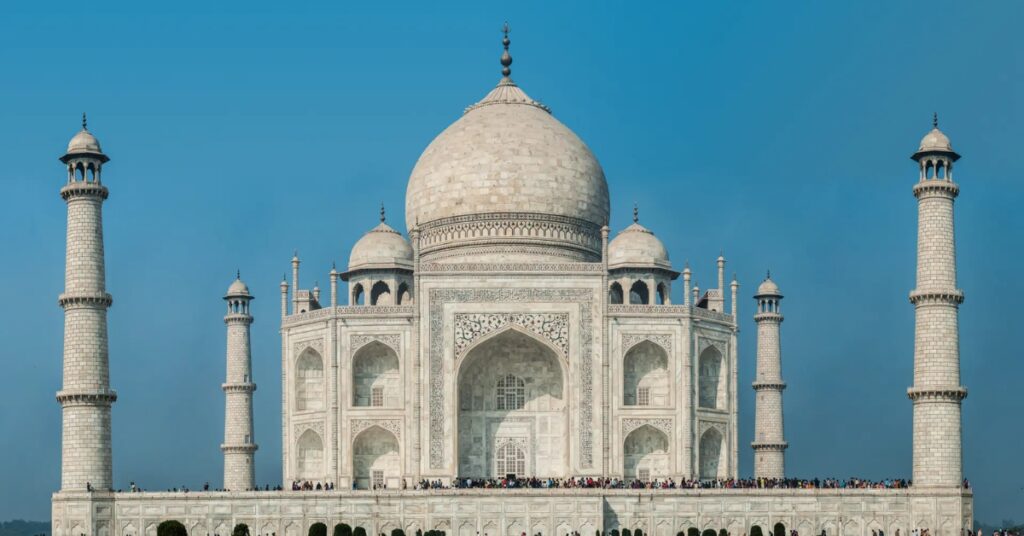
The heritage list is genuinely impressive: the Taj Mahal (commissioned 1632), the Victoria Memorial in Kolkata, the Dilwara Temples at Mount Abu, Birla Mandir, and most recently large sections of the Ram Mandir at Ayodhya. The GI registration came through in 2015, which formally tied the name to stone quarried in the Makrana region of Nagaur.
Where it comes from: the Makrana marble mines
Makrana is a town in Nagaur district, Rajasthan. The mining belt runs across several distinct zones, and this matters more than most buyers realise — the mine determines the variety, and the variety determines the price.
The main zones are Doongri (or Dungri), Albeta, Kumari, Chak Doongri, Ulodi, Saabwali and Gulabi. Each produces stone with its own colour, vein character and density. Two slabs can both be legitimately “Makrana marble Rajasthan” and differ by ₹300 per square foot because one came out of Doongri and the other out of Kumari.
Anyone quoting you a single flat rate for “Makrana” either doesn’t know the material or is hoping you don’t.
Types of Makrana marble
Here are the varieties you’ll actually encounter in the market, roughly in descending order of grade.
Makrana Dungri (Doongri)
The top tier. Milky, near-uniform white with minimal veining and a very fine, tight crystal structure. This is statue-grade stone — the material behind most premium Makrana marble murti work and the finest mandir carving. Large clean blocks are increasingly scarce, which is why prices for this grade have climbed steadily.
If someone shows you a genuinely veinless, dense white slab and quotes ₹150, be suspicious.
Makrana Albeta
Arguably the most recognisable Makrana marble texture — a warm white body with soft grey-brown veining running through it, sometimes described as a light “sugar” pattern. It’s dense, holds polish exceptionally well, and it’s the variety most closely associated with the Taj Mahal’s inlay-grade panels.
Albeta is the sweet spot for a lot of residential projects: it looks like heritage stone but costs meaningfully less than Dungri.
Makrana Kumari
White to off-white with a slightly cream undertone and more visible grain. It’s the workhorse variety — the most commonly available, the most affordable, and completely respectable for large-area flooring where you need volume at a sensible rate.
Chak Dungri
Sits between Kumari and Dungri. Clean white with occasional light grey markings. Good compromise grade for temple flooring and premium residential work when Dungri is out of budget.
Ulodi and Saabwali
Both carry more pronounced grey veining and a slightly greyish base. Ulodi in particular has a character that works beautifully in contemporary interiors — people who reject “plain white” often end up choosing this. Priced moderately.
Pink Makrana Marble (Gulabi / Adanga)
The one people forget exists. A soft blush-pink to salmon body, sometimes with darker pink or brown veining. Historically used in temple architecture and now finding its way into feature walls, wash-basin counters and accent flooring. Pink Makrana marble is genuinely distinctive and, because demand is niche, often surprisingly reasonable.
Makrana Brown / Adanga Brown
Deeper brown-toned stone from the same belt. Limited supply, mostly used for borders, inlay and contrast work rather than full floors.
Makrana marble price in 2026
This is what most people came here for, so let’s be direct about it.
The figures below are indicative ex-Kishangarh rates for 2026, for 16–18 mm slabs, polished, before freight and taxes. Actual quotes move with block quality, slab size, thickness, order volume and current mine output. Treat this as a range to negotiate within, not a fixed makrana marble price list.
| Variety | Grade | Indicative price (₹ / sq ft) |
|---|---|---|
| Makrana Kumari | Commercial | ₹90 – ₹160 |
| Makrana Saabwali | Commercial to standard | ₹110 – ₹190 |
| Makrana Ulodi | Standard | ₹130 – ₹230 |
| Pink Makrana (Gulabi) | Standard | ₹120 – ₹260 |
| Chak Dungri | Premium | ₹180 – ₹320 |
| Makrana Albeta | Premium | ₹250 – ₹450 |
| Makrana Dungri | Super premium | ₹350 – ₹650 |
| Dungri, statue / carving grade | Select block | ₹700 – ₹1,400+ |
A few honest observations on these numbers.
Anything below roughly ₹90 per sq ft sold as Makrana deserves scrutiny. At that level you are usually looking at Banswara, Morwad, Rajnagar white, or imported Vietnamese white marble carrying a Makrana label. Those are perfectly good stones — they’re just not Makrana, and they shouldn’t be priced as such.
The original Makrana marble price per square foot for select Dungri has effectively doubled over the last decade. Yield from the older mines has dropped, extraction depth has increased, and large defect-free blocks are the constraint. If you’re planning a temple or a statue commission, budget accordingly and book early.
Makrana marble tiles cost differently from slabs. Pre-cut tiles in standard sizes (600×600, 800×800, 2×2 ft) usually carry a ₹20–₹50 per sq ft premium over raw slab because the cutting, edge finishing and calibration are already done — but you also lose almost nothing to on-site wastage, which often makes tiles the cheaper option overall for straightforward rooms.
What actually moves the makrana marble rate
Six things, roughly in order of impact:
- Variety and mine of origin — the single biggest factor, as above.
- Thickness — 16 mm is standard for flooring; 18 mm and 20 mm add roughly 12–25% and are worth it for high-traffic commercial floors and countertops.
- Slab size and block yield — large uninterrupted slabs command a premium because they come from bigger, cleaner blocks.
- Finish — polished is the baseline. Honed, leather and antique finishes typically add ₹20–₹60 per sq ft.
- Order volume — pricing structurally changes above roughly 2,000 sq ft. Below 500 sq ft you’re generally paying retail.
- Freight — this is where landed cost quietly inflates.
City-wise landed cost
Since the stone leaves from one place, the delta is essentially transport and local handling. Rough additions to ex-Kishangarh rates, for full-truck loads:
- Jaipur — add roughly ₹8–₹15 / sq ft. Makrana marble price in Jaipur is the closest you’ll get to mine rate.
- Delhi NCR — add roughly ₹20–₹35 / sq ft. Note that Delhi’s marble markets carry their own retail margin on top; buying direct from Kishangarh usually lands cheaper even after freight.
- Ahmedabad / Mumbai — add roughly ₹30–₹50 / sq ft.
- Kolkata — add roughly ₹45–₹70 / sq ft, being the longest haul of the four.
Partial loads change this maths considerably. If you’re buying under about 800 sq ft, consolidate with something else or expect freight per square foot to look painful.
Makrana vs the alternatives
Morwad marble vs Makrana marble
The most common comparison we get asked about, and a fair one. Morwad (from the Rajsamand belt) is a good white marble — brighter and more uniformly white than most Makrana grades, and considerably cheaper.
Where they part ways is over time. Morwad is softer, more porous, and more prone to yellowing and staining without sealing. Makrana holds up better across decades and doesn’t need the same maintenance discipline.
Blunt version: if the floor needs to look good for ten years, Morwad is excellent value. If it needs to look good for fifty, or if it’s going into a temple, pay for Makrana.
Makrana vs Italian marble
Different products, not competing ones. Italian marbles like Statuario and Calacatta deliver dramatic, high-contrast veining and a very bright white — a distinctly modern luxury look. Makrana is warmer, quieter, denser and needs far less babying.
Italian marble is generally softer and requires more careful maintenance. Makrana handles Indian household reality — water, foot traffic, the occasional spill — with less anxiety. Many of our clients use both: Italian in the living areas, Makrana in the pooja room and entrance.
Where Makrana marble works best
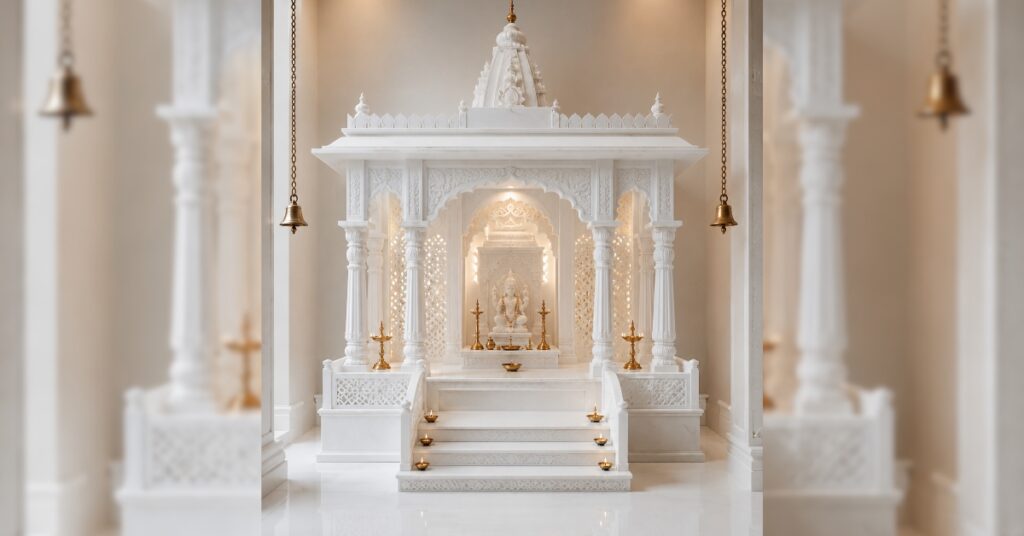
Temple and mandir work. This is where it’s genuinely unmatched. Makrana marble temple construction, mandir design, and carved murti work all rely on the stone’s density and carving behaviour — it takes fine detail without chipping and stays white under daily ritual use.
Pooja rooms in homes. Same logic at smaller scale. A Makrana pooja room floor and mandir unit will outlast the rest of the interior.
Flooring. Makrana marble flooring designs range from plain full-floor layouts to inlay borders, geometric patterns and mixed-tone work using Kumari with Ulodi or pink accents. The classic combination — white field with a contrasting border — has been done for four centuries and still looks right. you can also check best marble for flooring in India.
Staircases and entrance lobbies. Density and edge strength make it a strong choice for treads and risers.
Wall cladding and feature walls. Especially Ulodi and pink Makrana, which carry enough visual character to hold a wall on their own.
Where we’d hesitate: kitchen countertops with heavy acidic use. It’s marble — lemon, vinegar and tomato will etch it eventually. It’s manageable with sealing and care, but if the kitchen is chaotic, granite or quartzite is the more forgiving call.
How to spot original Makrana marble
This section matters more than the pricing table, honestly.
Ask which mine. A real supplier answers instantly — Dungri, Albeta, Kumari, Ulodi. Vagueness is the tell.
Check the water absorption. Pour water on an unpolished edge or the back of the slab. Makrana absorbs very slowly and the dark patch fades quickly. Softer white marbles drink it in and stay dark for minutes.
Look at the back, not the front. Any slab can be polished to look good. The reverse face shows you the true crystal structure and whether the stone has been resin-backed or netted — genuine Makrana rarely needs either.
Tap it. Dense Makrana rings. Porous stone thuds. Crude, but experienced buyers still do it.
Watch the price. Real Dungri at Kumari rates does not exist. The market is not that inefficient.
Ask for GI documentation on higher-value orders. Registered Makrana suppliers can substantiate origin.
Care and maintenance
Makrana is low-maintenance by marble standards, but not maintenance-free.
- Sweep dry, then mop with plain water or a pH-neutral cleaner. That’s 90% of it.
- Avoid acidic cleaners — vinegar, lemon-based products, and harsh floor acids will dull the surface over time.
- Wipe spills of turmeric, oil and beetroot reasonably promptly. Makrana resists them better than most marbles, but nothing is immune.
- Re-polish every 5–8 years for high-traffic floors, longer for residential. Many older Makrana floors go a decade or more.
- Use mats at entry points. Grit underfoot causes more damage than anything else.
Buying checklist
Before you place an order, get clarity on:
- Variety and mine name in writing on the quotation
- Thickness — confirm whether it’s 16, 18 or 20 mm
- Slab dimensions and count, not just total square footage
- Finish — polished, honed, or otherwise
- Whether the rate is ex-works or delivered, and whether loading and unloading are included
- Wastage allowance — budget 8–12% for straightforward layouts, more for patterned work
- Physical slab selection — for anything over about 1,000 sq ft, view and mark the actual lot rather than approving a sample piece
That last point saves more disputes than everything else combined. Natural stone varies block to block; a 4-inch sample tells you almost nothing about how 1,500 sq ft will read on a floor.
Buying Makrana from Kishangarh
Kishangarh is the largest natural stone market in India and sits closest to the Makrana belt, which means the shortest supply chain and the most transparent pricing you’ll find anywhere in the country.
At Bhutra Marble we’ve been sourcing, processing and supplying natural stone from here since 1978, and we stock Makrana varieties alongside imported and Indian marble, granite, onyx and quartzite. If you’re planning a temple, a home, or a large project and want current rates on a specific variety and thickness, get in touch — we’ll quote against your actual slab requirement rather than a generic list, and you’re welcome to visit and select the lot yourself.
📍 Bhutra Marble — KH No. 228, 194, Makrana Road, Khatoli, Kishangarh, Rajasthan 305801
📞 Call / WhatsApp: +91 90011 56068
✉️ Email: info@bhutrastones.com
Request a Free Quote → | WhatsApp Now → | Get Directions to Our Showroom →
Prices in this guide are indicative for 2026 and subject to change with mine output, grade and order size. Please request a current quotation for your specific requirement.
FAQ :-
Commercial grades such as Kumari typically run ₹90–₹160 per sq ft ex-Kishangarh. Premium Albeta sits around ₹250–₹450, and select Dungri ranges from ₹350 to ₹650, with carving-grade material going higher. Freight, thickness and volume all shift the final number.
Dungri for purity and carving, Albeta for the classic veined heritage look with better value, Kumari for large-area flooring on a budget. "Best" depends entirely on the application.
Yes — the Taj Mahal was built using marble from the Makrana quarries. The specific grades used were exceptionally fine, comparable to today's top Dungri and Albeta selections.
Genuine Makrana is notably resistant to yellowing, which is its main advantage over softer white marbles. Yellowing in a "Makrana" floor is usually a sign the stone wasn't Makrana to begin with, or that moisture is reaching it from below through improper laying.
Pink Makrana usually costs less than premium white grades — roughly ₹120–₹260 per sq ft — because demand is narrower, not because quality is lower.
Yes, and historically it has been extensively. It weathers well, though outdoor surfaces will need periodic cleaning and will develop a natural patina.