


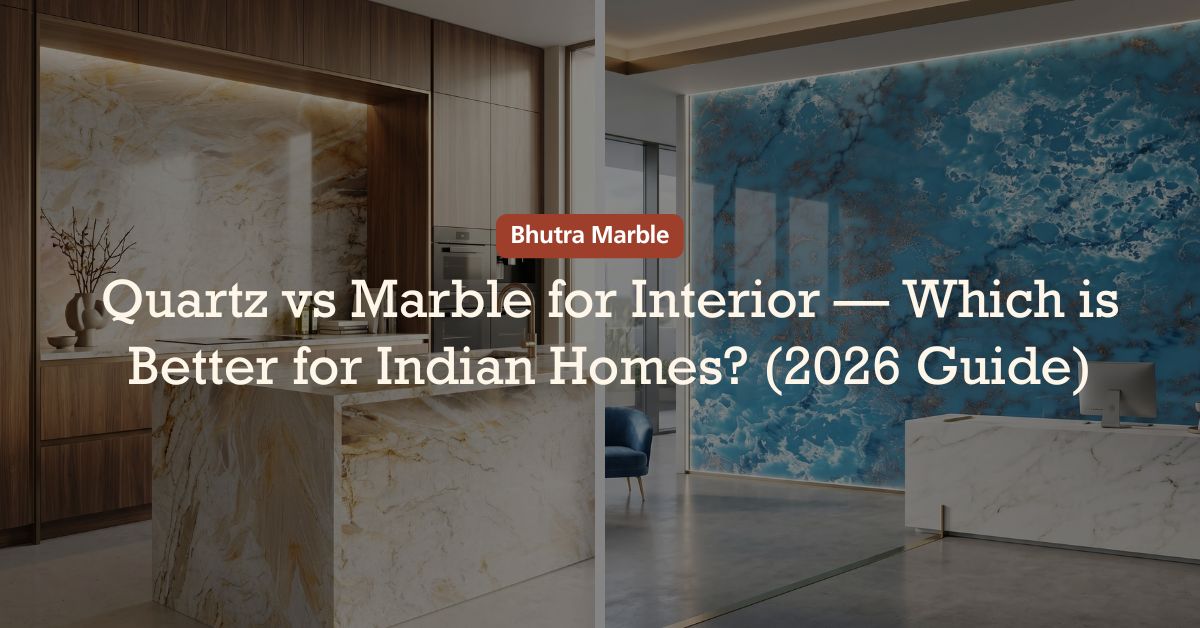
Quartz vs Marble for Interior
Quick Answer — Bhutra Marble Expert (45+ years in natural stone): For Indian home interiors, marble wins on aesthetics, natural luxury, and long-term property value. Quartz wins on zero maintenance, consistency, and durability in high-use areas.
📌 2026 Price Snapshot (Kishangarh, supply only):
Italian Marble: ₹250 – ₹3,000 per sq ft
Indian Marble: ₹80 – ₹500 per sq ft
Engineered Quartz: ₹120 – ₹900 per sq ft
Our honest recommendation: Choose marble for living rooms, master bedrooms, pooja rooms, and feature walls — anywhere beauty matters. Choose quartz for kitchen countertops or utility areas where zero-maintenance is the priority. Never choose quartz just because someone told you marble is “too hard to maintain” — with one annual sealing, marble is perfectly practical for most Indian homes.
INTRODUCTION
Quartz or marble — it is one of the most debated choices in Indian interior design today. Walk into any showroom in Kishangarh, Delhi, or Bengaluru and you will hear strong opinions on both sides.
Marble lovers will tell you nothing compares to the natural luxury of real stone. Quartz advocates will say modern engineered surfaces are smarter, tougher, and easier to live with.
Both sides have a point. But the honest answer is not the same for every room, every budget, or every family.
After 48 years of supplying both natural marble and quartz slabs to Indian homeowners, architects, and interior designers, here is our complete, unbiased comparison — with 2026 prices, room-wise guidance, and our expert verdict for Indian conditions.
WHAT EXACTLY ARE THESE MATERIALS?
Before comparing, it is important to understand what you are actually buying.
Marble is a natural metamorphic rock formed when limestone is subjected to extreme heat and pressure deep within the earth. Every slab is unique — no two pieces of marble look exactly alike. The veining, colour, and pattern are all created by nature over millions of years.
Marble used in Indian interiors comes from two primary sources:
- Italian marble — quarried in Carrara, Tuscany and other Italian regions. Known for pure whites, dramatic veining, and international luxury status. Price: ₹250–₹3,000+ per sq ft.
- Indian marble — quarried in Rajasthan (Makrana, Kishangarh), Madhya Pradesh (Jabalpur, Katni), and other regions. More affordable, good durability. Price: ₹80–₹500 per sq ft.
Quartz (engineered quartz) is a man-made surface — typically 90–95% crushed natural quartz mixed with resins, pigments, and binders. It is manufactured in controlled factory conditions, which means every slab looks the same. The pattern and colour are designed and replicated consistently across batches.
Quartz is not a natural stone. It is an engineered product that mimics the appearance of natural stone while offering improved consistency and lower maintenance.
QUARTZ VS MARBLE — COMPLETE COMPARISON TABLE
| Feature | Marble (Italian/Indian) | Engineered Quartz |
|---|---|---|
| Material type | Natural stone | Man-made (90–95% quartz + resin) |
| Appearance | Unique every slab — natural veining | Consistent — same pattern batch to batch |
| Hardness (Mohs) | 3–4 (softer) | 7 (harder) |
| Scratch resistance | Moderate — can scratch | High — scratch-resistant |
| Heat resistance | Good | Moderate — resin can discolour above 150°C |
| Stain resistance | Porous — needs sealing | Non-porous — stain-resistant |
| Acid resistance | Low — etches with lemon, vinegar | High — acid-resistant |
| Maintenance | Seal once a year, pH-neutral cleaner | Wipe clean with any mild cleaner |
| Natural feel | Yes — cool, unique, luxurious | No — engineered feel |
| Property value impact | High — premium buyers prefer marble | Moderate |
| Eco-friendliness | Natural — no resins or chemicals | Contains resins and synthetic binders |
| Longevity | 50–100+ years with care | 15–25 years (resin degrades over time) |
| Price in India (2026) | ₹80 – ₹3,000 per sq ft | ₹120 – ₹900 per sq ft |
| Best for | Living rooms, bedrooms, feature walls, flooring | Kitchen countertops, utility areas |
WHERE MARBLE WINS — AND WHY
1. Aesthetics and natural beauty
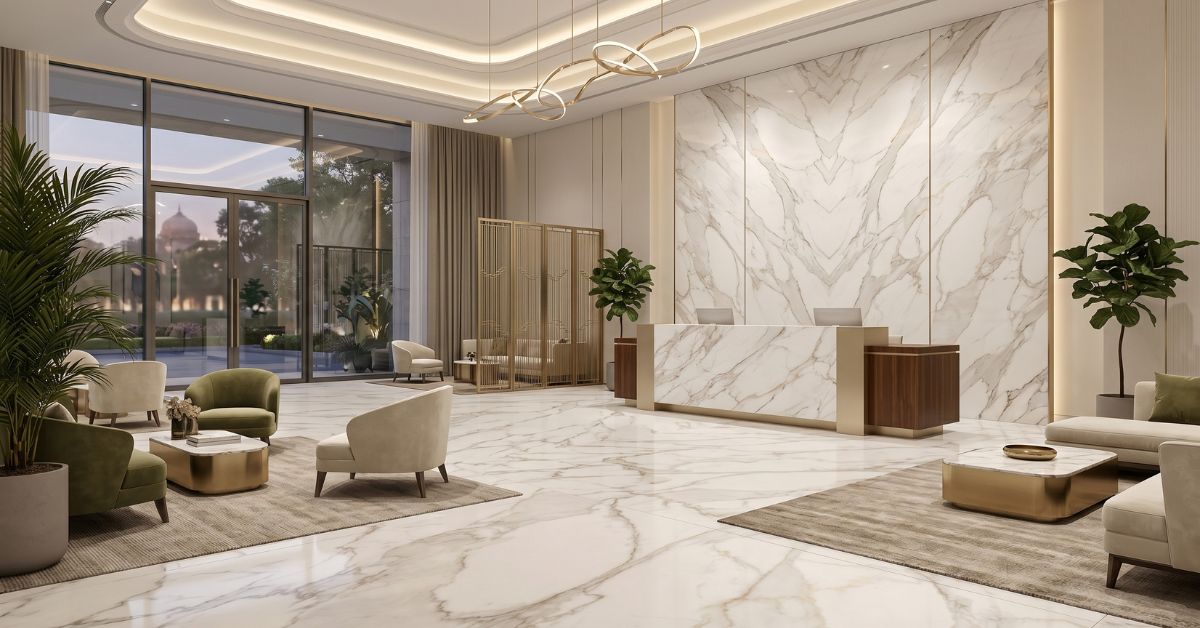
No engineered surface has been able to replicate the depth, translucency, and uniqueness of natural marble. The way light moves through a polished Statuario slab, the warmth of Calacatta Gold veining, the quiet elegance of Carrara white — these are properties that come from 40 million years of geological process and cannot be manufactured.
In Indian home design — especially in master bedrooms, living rooms, and pooja rooms — marble creates an emotional response that quartz simply does not. This is why luxury residential projects in Mumbai, Delhi, and Bengaluru still specify Italian marble as their primary interior stone in 2026.
2. Long-term property value
Real estate data from premium Indian housing markets consistently shows that marble-finished interiors command higher resale values than quartz-finished ones. Buyers recognise marble. It signals quality, permanence, and taste in a way that engineered stone does not — yet.
3. Actual lifespan — marble lasts longer
A well-maintained marble floor in an Indian home can last 50–100 years. The marble in Humayun’s Tomb has lasted 500 years. Engineered quartz, by contrast, uses polymer resins that begin to degrade and discolour over 15–25 years, particularly under prolonged UV exposure. For flooring especially, marble is the more durable long-term choice.
4. Heat resistance
Marble stays naturally cool and handles heat well — important in Indian summers. Engineered quartz, by contrast, contains polymer resins that can discolour or warp when exposed to temperatures above 150°C. This is a real limitation for kitchen worktops placed near cooking surfaces.
5. Eco-credentials
Natural marble is quarried stone — no synthetic resins, no chemical binders. Engineered quartz is approximately 5–10% synthetic polymer. For homeowners making environmentally conscious choices, natural stone is the cleaner option.
WHERE QUARTZ WINS — AND WHY
1. Zero maintenance for high-use surfaces
Quartz is non-porous. It does not need sealing. You can clean it with any mild household cleaner. For busy families with children, domestic help managing large homes, or rental properties where maintenance cannot be guaranteed, quartz on kitchen countertops and utility surfaces makes practical sense.
2. Resistance to acids and common Indian kitchen ingredients
This is the most important practical advantage of quartz in Indian kitchens. Lemon juice, tamarind, tomato, vinegar, and most Indian cooking acids will etch polished marble. Quartz handles all of these without any surface damage. If your kitchen sees heavy Indian cooking daily, quartz on the countertop is a more sensible choice than marble.
3. Consistency across a large area
Because quartz is manufactured, every slab from a batch looks identical. This is useful for very large areas — a commercial office floor, a hotel corridor — where matching natural stone slabs precisely would be difficult and expensive.
4. Lower entry price for a clean look
Basic engineered quartz starts at ₹120–₹200 per sq ft — comparable to affordable Indian marble but with better stain resistance. For budget projects that need a clean, modern look without natural stone complexity, quartz is a reasonable choice.
ROOM-BY-ROOM GUIDE : WHICH TO CHOOSE WHERE
Living Room Flooring
Recommendation: Marble — clear winner The living room is where aesthetics matter most and foot traffic is manageable. Italian or Indian marble flooring in a living room is the single highest-impact interior choice available at any price point. Polished white or beige marble reflects light, makes rooms feel larger, and signals quality to every visitor. Quartz is rarely used for flooring — it is primarily a countertop/surface material.
Master Bedroom Flooring
Recommendation: Marble Marble stays cool underfoot, which is genuinely valued in Indian summers. The luxury feel of marble in a master bedroom is unmatched. Honed finish marble is preferred for bedrooms — it is softer in appearance and less reflective than high polish.
Kitchen Countertop
Recommendation: Quartz (or granite) This is the one room where quartz’s practical advantages clearly outweigh marble’s aesthetic ones. Indian cooking — with its daily use of lemon, tamarind, and acidic ingredients — is genuinely hard on polished marble. Quartz handles it without damage. If you insist on marble in the kitchen (and many Indian homes do this beautifully), choose a honed finish and accept that you will need to reseal it more frequently and wipe spills immediately.
Bathroom Walls and Floors
Recommendation: Marble (honed finish) Bathrooms are where marble looks most spectacular and where its porosity is most manageable — soap and water are far less damaging than kitchen acids. Use honed finish on floors for grip. Seal on installation and reseal every 12–18 months.
Pooja Room
Recommendation: Marble — without question White marble in a pooja room is a deeply rooted Indian tradition with cultural and spiritual significance. No engineered surface is appropriate here. Makrana white, Italian Carrara, or Statuario for a premium pooja room.
Feature Wall / TV Wall / Accent Wall
Recommendation: Marble — dramatic impact Book-matched marble slabs on a feature wall create an effect no quartz product can match. This is the single application where premium Italian marble delivers the most return on investment — visually and in property value.
Kitchen Island or Dining Table Top
Recommendation: Marble (sealed) or quartz depending on use If you entertain frequently and the surface sees glasses, plates, and candles — sealed marble looks extraordinary. If the surface doubles as a food prep area with heavy chopping and acids — quartz is more practical. Many Indian homes use marble on the island top for aesthetics and quartz on the working counter for practicality.
2026 PRICE COMPARISON — INDIA
Prices from Bhutra Marble showroom, Kishangarh, Rajasthan. Updated June 2026. Supply price only — installation separate.
Marble Prices (per sq ft)
| Type | Grade | Price Range |
|---|---|---|
| Indian Marble — Makrana White | Standard | ₹120 – ₹350 |
| Indian Marble — Albeta / Morwad | Budget | ₹80 – ₹200 |
| Italian Carrara White | Standard import | ₹450 – ₹650 |
| Italian Statuario / Michelangelo | Premium import | ₹450 – ₹1,800+ |
| Italian Calacatta Gold | Super premium | ₹700 – ₹3,000 |
Marble bathroom supply prices in India range from budget Indian marble at around ₹80/sq ft to super-premium Italian marble up to ₹3,000/sq ft, depending on type and grade. If you are comparing marble price in India for bathroom projects, remember that these are supply-only rates and installation is charged separately. [→ See our full Italian marble pricing guide for current slab quotes]
Quartz Prices (per sq ft)
| Type | Grade | Price Range |
|---|---|---|
| Indian engineered quartz | Basic | ₹120 – ₹250 |
| Mid-range imported quartz | Standard | ₹300 – ₹550 |
| Premium imported quartz (Silestone, Caesarstone) | Premium | ₹600 – ₹900 |
Installation Cost (approximate, labour only)
| Application | Cost per sq ft |
|---|---|
| Marble flooring installation | ₹40 – ₹80 |
| Marble wall cladding | ₹60 – ₹100 |
| Quartz countertop installation | ₹50 – ₹120 |
Buying tip : Purchasing marble directly from Kishangarh saves 20–35% compared to buying through local retailers in Mumbai, Delhi, Pune, or Bengaluru — because you are cutting out the middleman’s margin. Contact Bhutra Marble for current slab pricing and transit quotes to your city.
THE MAINTENANCE REALITY — MARBLE IS NOT AS HARD AS YOU THINK
The single biggest myth in Indian interior design is that marble is “too difficult to maintain.” This keeps many homeowners from choosing a material they would genuinely love — unnecessarily.
Here is the honest maintenance reality for marble in Indian homes:
Annual sealing: 20 minutes, once a year. Apply a penetrating stone sealer with a cloth. Leave for 15 minutes. Wipe off. Done. This is the only special maintenance marble requires. One sealed marble surface resists the vast majority of stains effectively.
Daily cleaning: pH-neutral stone cleaner or plain water. No special equipment. No expensive products. Just avoid acidic cleaners (Harpic, bleach, vinegar, lemon-based products) and you are fine. Most Indian households manage marble flooring for decades with no issues.
What actually damages marble:
- Acidic cleaning products (Harpic, Colin with acid, tile cleaners)
- Leaving lemon juice or tamarind sitting on a polished surface for extended periods
- Dragging heavy furniture without felt pads
What does NOT damage sealed marble:
- Water, soap, shampoo, toothpaste, most bathroom products
- Normal foot traffic for 50+ years
- Hot cups of tea or coffee placed directly on the surface
Quartz maintenance is genuinely simpler — but the gap between marble and quartz maintenance is far smaller than most people believe.
BHUTRA MARBLE EXPERT VERDICT

After 48 years of supplying both natural stone and quartz to Indian homes, our honest recommendation:
Choose marble if:
You want your home to look and feel genuinely luxurious
The space is a living room, master bedroom, pooja room, bathroom, or feature wall
You are considering marble for bathroom walls, flooring, vanity tops, or luxury shower areas
You are willing to seal the stone once a year — a 20-minute task
Long-term property value matters to you
You want a material that will outlast the house itself
Choose quartz if:
The surface is a kitchen countertop in a home with heavy daily Indian cooking
It is a rental property, children’s room, or utility area where maintenance cannot be guaranteed
You need a consistent pattern across a very large commercial area
Your budget is under ₹150/sq ft and you need a clean, practical surface
The smartest approach most architects recommend : Marble for flooring and walls throughout. Quartz only on the kitchen working countertop. This gives you the full luxury of natural stone in every space you actually see and experience — with zero-maintenance practicality exactly where it is needed most.
FAQ
Still deciding between marble and quartz for your home?
Visit our Kishangarh showroom to see full-size slabs of both side by side — no appointment needed. Or WhatsApp us photos of your space and we will recommend the right material, grade, and finish for your budget.
Open Monday–Sunday, 10 AM – 7:30 PM.