

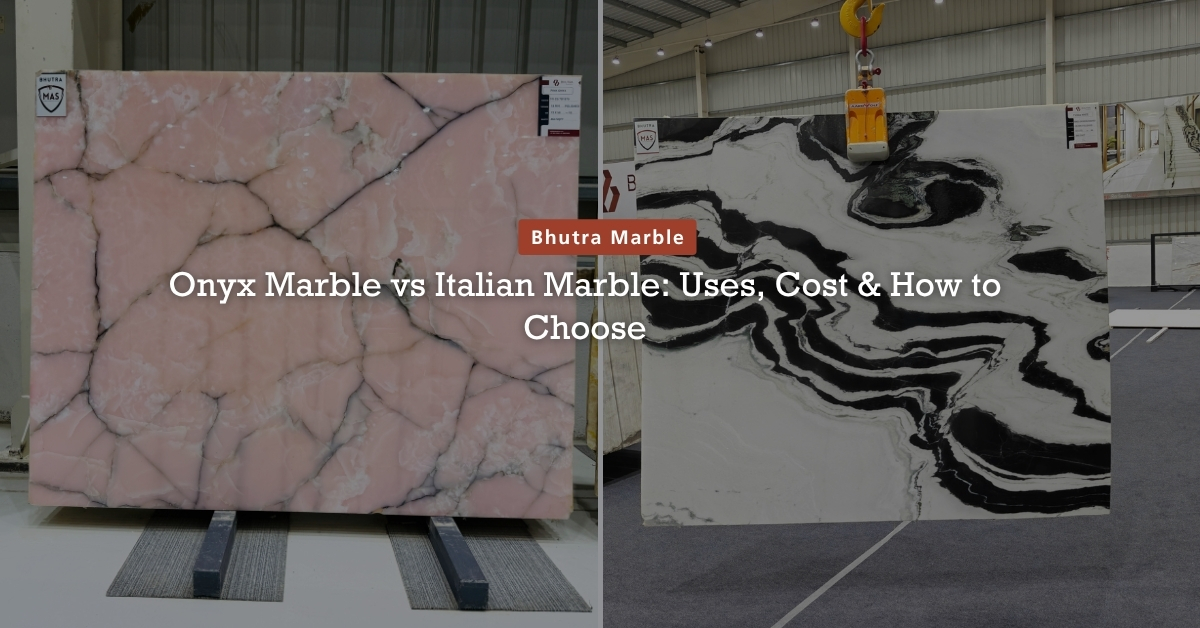
Here is the thing almost no one tells you: onyx is not actually a marble, and most onyx has nothing to do with Italy. Both facts change the decision you are about to make.
We have been trading imported stone out of Kishangarh since 1978, and this comparison comes up most often in two situations. Someone wants a backlit feature wall and is worried onyx is too delicate. Or someone has fallen for an onyx dining table and wants to know whether it will survive a family.
Those are two different answers. This guide covers what each stone physically is, how they compare on numbers rather than adjectives, which one belongs in which part of a home, and how to tell natural onyx from the resin look-alikes now common in the market.
The Short Answer
If you want the decision without the reasoning:
- Choose Italian marble for anything you walk on, eat off, or use every day. Floors, kitchen counters, stairs, bathroom vanities, large continuous surfaces.
- Choose onyx for surfaces people look at rather than use. Backlit walls, bar fronts, reception counters, powder-room cladding, console and accent tables, basins.
- For a dining table, Italian marble is the safer top. Onyx can work, but only with conditions, and those conditions are covered in detail below.
Onyx is the more dramatic stone and the more fragile one. Italian marble is the more practical stone and, variety for variety, usually the more affordable one. Most good projects use both, in the right places.
Onyx Is Not Technically a Marble

The trade calls it “onyx marble” and that name is now too established to fight, but it is worth understanding what you are buying.
Italian marble is metamorphic rock. Limestone was buried, squeezed and heated over millions of years until its calcite recrystallised into the dense, interlocking structure that takes a mirror polish. That recrystallisation is what gives marble its strength.
Onyx never went through that. It forms at or near the surface, where groundwater carrying dissolved calcite emerges from a spring or seeps into a cave. As the water evaporates, it leaves calcite behind in thin layers, one after another, over a very long time. The bands you see are a record of how fast the water was flowing and what it carried. The honey and amber tones that onyx is famous for come from iron oxide in that water.
Geologically, this makes onyx a close relative of travertine rather than of marble. Same mineral, same method of formation. The difference is that travertine traps gas and ends up porous and pitted, while onyx builds up smooth and dense enough to polish and to let light through.
So onyx and marble are siblings in the commercial sense, because both are calcite and both take a polish. They are not the same rock, and the layered structure is exactly why onyx behaves the way it does: it is weaker along its banding, it tends to carry natural fissures, and it needs more support than marble does.
The hardness number most suppliers get wrong
You will see onyx quoted at 6.5 to 7 on the Mohs hardness scale. That figure is wrong for the stone in your slab, and the mistake is common enough that it is worth naming.
There are two different materials called onyx. The gemstone onyx used in jewellery is a banded form of chalcedony, which is a quartz mineral, and that is the one with hardness around 6.5 to 7. The architectural onyx sold as slabs is banded calcite. Calcite is the reference mineral for 3 on the Mohs scale.
So your onyx slab sits at roughly 3, which is soft enough that a dropped ring, a car key, or grit tracked in on a shoe will mark it. If a supplier quotes you 6.5, they are either quoting the gemstone by mistake or they do not know the difference. Either way, plan your project around 3.
Is Onyx an Italian Marble?
Usually not, and this is one of the most common misunderstandings we deal with.
Commercial onyx comes mainly from Iran, Turkey, Pakistan, Mexico, Afghanistan and Brazil. Iran and Mexico between them supply a large share of what the world installs. Italy does have some onyx of its own, and Italian companies are major processors and traders of it, so a slab can genuinely arrive from Italy without having been quarried there.
That is the useful distinction. When you see “Italian onyx” on a quotation, it almost always describes where the block was cut, polished and sold from, not where it came out of the ground. It is a trade route, not an origin.
Italian marble, by contrast, is a genuine origin claim. Carrara, Calacatta, Statuario and Botticino are named after the Italian regions and quarries they come from, and that origin is the basis of their value. If someone sells you “Italian marble” the country of origin is the point; if someone sells you “Italian onyx” the country is mostly packaging.
None of this makes onyx worse. It is a legitimate, often expensive, genuinely rare natural stone. It simply is not a variety of Italian marble, and anyone comparing the two as though onyx were one more Italian marble option is starting from the wrong place.
Onyx vs Italian Marble, Side by Side
Adjectives are not much use here, so these are the properties that actually affect your project.
| Property | Onyx | Italian Marble |
|---|---|---|
| Rock type | Banded calcite, deposited by mineral water at the surface. Sedimentary. | Recrystallised limestone. Metamorphic. |
| Mohs hardness | About 3 | About 3 to 4 |
| Scratch resistance | Poor. Among the softest stones used in interiors. | Moderate. Marks, but tolerates daily use. |
| Acid sensitivity | Very high. Etches readily. | High. Etches, but less readily. |
| Porosity | Higher. Stains faster, needs sealing more often. | Lower, and varies by variety. |
| Translucency | Yes. This is the whole point of the stone. | No, apart from a faint glow in very thin white varieties. |
| Structural integrity | Often fissured. Slabs normally ship with fibreglass mesh and resin backing. | Sound. Resin and mesh are used for finish and strength, not survival. |
| Usual slab thickness | 20 mm or less, often calibrated to 16 to 18 mm for backlighting. | 16 to 20 mm typical for flooring, 20 to 30 mm for counters. |
| Slab size | Smaller and less predictable. Blocks are rarely large. | Larger and more consistent. Easier to plan big layouts. |
| Wastage | Higher, because of fissures, smaller slabs and heavy pattern matching. | Plan 15 to 20% for most layouts. |
| Best at | Vertical, backlit, decorative, low-contact surfaces. | Floors, counters, stairs, wet areas, large continuous runs. |
| Price direction | Generally higher, and the premium varieties are much higher. | Very wide range depending on variety and grade. |
Read that table as one sentence: onyx wins on appearance and loses on everything to do with wear. That is not a flaw in the stone, it is a brief for where to put it.
Is Onyx Marble Good for a Dining Table?
The case against
A dining table is one of the worst environments you can put onyx in. Think about what lands on it. Lemon, curd, tamarind, tomato, wine, cola, vinegar in the salad. Every one of those is acidic, and onyx etches very readily, which means a dull, slightly rough ring that no amount of cleaning will remove. Sealing does not prevent this. A sealer slows absorption and reduces staining; etching is a chemical reaction with the stone surface itself, and no impregnating sealer stops it.
Then add hardness. At around 3 on the Mohs scale, a serving dish dragged across the top, a ring, a child’s toy or a steel thali edge will leave visible scratches. And because onyx is layered and often fissured, a thin unsupported top can crack where it overhangs.
When onyx does work on a table
Despite all of that, we have supplied plenty of onyx tables that clients are still happy with. The ones that work tend to share these conditions:
- It is not the everyday table. A formal dining room used twice a week, or a console, coffee or centre table, is a very different load from the table where a family eats three meals a day.
- There is a protective layer in daily use. Placemats, runners, coasters and trivets, used consistently rather than occasionally.
- The finish is honed or satin, not high polish. Etching is damage to gloss. On a honed surface there is far less gloss to lose, so marks are dramatically less visible. This single choice does more than anything else to make onyx survivable on a horizontal surface.
- It is properly supported. A full sub-frame or honeycomb backing under the slab, not just four legs and an unsupported span.
- It is sealed on a schedule. Roughly every 6 to 12 months for a table in use. Test it rather than guessing: put a few drops of water on the surface and wait. If it soaks in and darkens the stone within 5 to 10 minutes instead of beading, it is due.
- The owner accepts patina. Some clients genuinely like that a stone records its use. Others are upset by the first mark. Be honest with yourself about which one you are.
The option most people do not consider
If what you actually love is the glow, you can have it without putting onyx under the plates. Use onyx as a backlit base, apron or pedestal and an Italian marble top. You get the drama at eye level and the practicality where the food goes. We have done this for several clients who came in asking for a full onyx table and left happier with the hybrid.
The other honest answer: if a hard-wearing, low-worry top is the priority, a well-chosen Italian marble will serve you better, and if you want to know how to deal with the marks it does pick up, we have a separate guide on removing stains and etch marks from marble.
Where Each Stone Belongs
| Application | Onyx | Italian Marble |
|---|---|---|
| Backlit feature wall | Ideal. Nothing else does this. | Not suitable |
| Bar front, reception counter | Ideal. Vertical, low contact, high impact. | Works, less dramatic |
| Powder room cladding, basins | Good. Light use, high visibility. | Good |
| Console, accent, centre table | Good with care | Good |
| Everyday dining table | Risky. See conditions above. | Better choice |
| Kitchen counter | Poor. Daily acid and knife contact. | Workable with sealing and care |
| Living and bedroom flooring | Poor. Too soft for foot traffic. | Ideal |
| Stairs, lobbies, high traffic | Avoid | Ideal |
| Shower floor, wet area underfoot | Avoid | Workable with the right finish |
| Outdoors, façades, terraces | Avoid. UV and weather degrade it. | Depends on variety and finish |
| Lamps, screens, sculpture, vases | Excellent | Excellent for carving |
How Backlit Onyx Is Actually Built
People ask for “backlit onyx” as though it were a finish you order. It is a small piece of construction, and it fails when it is treated casually. A proper backlit panel has four parts behind the stone:
- A thin enough slab. Light has to get through. That means 20 mm at most, and 16 to 18 mm calibrated is better. Thicker stone reads as a dark patch with a glow at the edges.
- An even light source. LED panels, not strips or spotlights. Point sources produce visible hot spots and you will see every one of them through translucent stone.
- A diffusion layer between the LEDs and the slab, to spread the light evenly across the back.
- A structural frame, usually aluminium honeycomb composite, carrying both the panel and the stone. Onyx this thin cannot support itself over a span.
Two things worth deciding early. Put the circuit on a dimmer: onyx at full brightness often looks cheap, and the stone usually looks best well below maximum. And plan access before installation, because an LED that fails behind a sealed stone panel is an expensive thing to reach.
One design note from experience: the veining you choose matters more when backlit than when lit from the front. Patterns that look subtle in daylight can become loud and busy once light passes through them. Always look at a sample with a light behind it before you commit, not just propped against a wall in the showroom.
Onyx Varieties You Will Actually See in India
Onyx is sold by colour family, and the names vary between suppliers. These are the ones commonly available here.
- Honey onyx — the classic warm amber, the colour most people picture. The iron oxide variety. Most forgiving to light.
- White onyx — pale and icy with grey or gold veining. The most popular for large backlit walls because it carries light cleanly.
- Green onyx — deep and dramatic, strong banding. Excellent vertically, busy in large horizontal spans.
- Lady onyx — soft greys and creams with fine, calm layering. One of the easier varieties to match across several slabs.
- Pink onyx — warm rose tones, often with heavy figuring. Strongly decorative.
- Blue onyx — rare and expensive. Worth checking carefully, because this is the colour most often imitated in resin.
- Mexican onyx — named for origin rather than colour, usually warm and heavily banded.
Two practical points. First, onyx varies more from slab to slab than almost any other stone, so a catalogue photograph tells you very little. Always select your actual slabs. Second, because blocks are small, a large wall may need several slabs that have to be book-matched or sequence-matched, which has to be planned at selection and not left to the installer.
You can see what is currently in the yard on our onyx collection page, and we will send photographs of specific slabs on request.
Natural Onyx vs Artificial Onyx
Translucent resin and engineered “onyx” panels are now widely sold, sometimes honestly as artificial and sometimes not. They are a legitimate product with real advantages. They are also a fraction of the cost, so it matters that you know which you are being quoted.
How to tell, on the slab itself:
| Check | Natural Onyx | Artificial or Resin Onyx |
|---|---|---|
| Dimensions | Irregular, dictated by the block. No two slabs identical. | Exact repeating sizes, typically 2400 × 1600 mm or 2400 × 1200 mm. |
| Thickness | Varies slightly across the slab. | Precisely uniform, often 13.5 or 15 mm. |
| Pattern | Never repeats. Bands wander and stop. | Repeats across slabs, or is suspiciously even. |
| The cut edge | Banding continues through the full thickness. | Pattern often sits in a surface layer only. |
| Fissures | Present. Normal, and usually resin-filled. | None. A completely flawless "onyx" slab is a warning sign. |
| Back face | Fibreglass mesh and resin backing. | Plain cast back, or a composite sandwich. |
| Touch | Cold, and slow to warm in your hand. | Warms quickly. Feels slightly plastic. |
| Weight | Heavier for the same size. | Noticeably lighter. |
Artificial onyx is genuinely the better choice in some situations: very large uniform backlit areas where consistency matters more than authenticity, tight budgets, or spans where natural onyx would be structurally awkward. It is far more consistent and much easier to fabricate. Just make sure you are choosing it rather than discovering it, and that you are not paying a natural-stone rate for it.
If you are ever unsure about a slab you have been offered elsewhere, send us a photograph of the face and the cut edge. We will tell you what it looks like to us, whether or not you buy from us.
What Each One Costs
Rates move with the exchange rate, the quarry, the block and the grade, so a number published in a blog post is out of date quickly. What is stable is the shape of the pricing, and that is more useful to plan around.
Onyx generally costs more than comparable Italian marble, and the gap is wider than the raw material difference suggests. Four reasons:
- Small blocks. Onyx deposits are limited, so fewer and smaller slabs come out of each block.
- Higher wastage. Fissures, banding and pattern matching all cost material.
- Reinforcement and handling. Mesh, resin and the care needed to move fragile slabs all add cost before the stone reaches you.
- Fabrication. Slower cutting, finer blades, more skill, and more risk of loss at the fabricator.
Italian marble covers a very wide band, from accessible commercial varieties to premium statuario at many times the price, which means there is almost always an Italian marble option inside a given budget. Onyx has a higher floor.
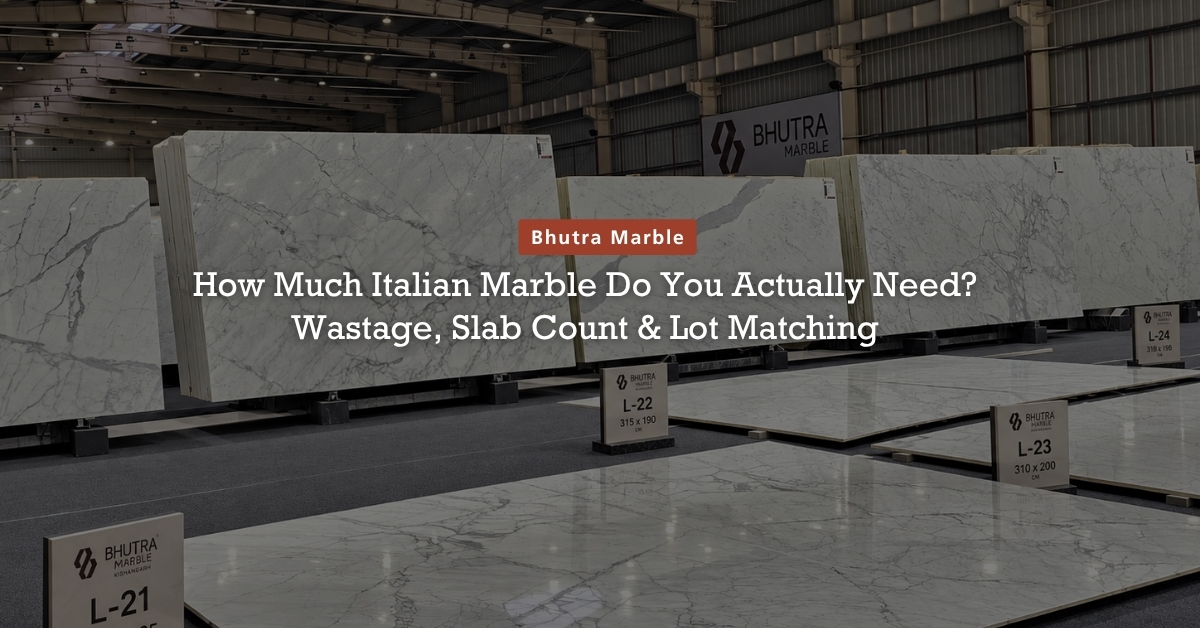
Two planning notes. Budget for finished and installed cost, not the slab rate, because onyx fabrication and backlighting carry a larger share of the total than they do for marble. And remember that both stones are sold from lots, so matching material across a large project depends on what is in the yard at the time.
For current numbers, our Italian marble rates are published and kept updated. Onyx we quote slab by slab, because the variation between individual slabs is too wide for a list price to mean anything.
Looking After Each Stone
Both are calcite, so the fundamentals are identical and the difference is how much margin for error you have.
- Keep every acid away from both. Lemon, vinegar, tamarind, curd, cola, descalers, toilet cleaners and most “all-purpose” floor cleaners. On onyx, contact time is measured in seconds rather than minutes.
- Clean with a pH-neutral stone cleaner, or plain water. Never scouring powder or an acidic bathroom cleaner.
- Blot spills, do not wipe them. Wiping spreads a spill and pushes it into the pores.
- Seal on a schedule, and test rather than guess. Water that soaks in and darkens the stone within 5 to 10 minutes means it is due. Onyx in use needs this every 6 to 12 months; marble flooring is less frequent.
- Know that sealing does not prevent etching. It reduces staining. Acid damage is to the stone surface itself.
- Dry-dust before mopping marble floors. Grit under a wet mop is what dulls a polished floor over a few years.
On slab quality before it ever reaches site: the epoxy and fibre reinforcement in the way we process and finish slabs before dispatch fills micro-gaps and improves surface stability, which matters a great deal for a fissured stone like onyx. To be clear about the limits, it makes a slab stronger and less absorbent. It does not make calcite acid-proof.
So Which Should You Choose?
Work backwards from the surface rather than from the stone.
Choose onyx when the surface is vertical or barely touched, when you want light coming through the stone, when the piece is a focal point rather than a work surface, and when you are willing to maintain it. A backlit onyx wall is something no other material can imitate convincingly, and in the right place it carries a whole room.
Choose Italian marble when the surface takes daily use, when you need large continuous areas to match, when you want a floor that can be re-polished in place and look new again at year ten, and when you would rather not think about maintenance constantly. If you are weighing the white varieties against each other, the differences between Statuario, Carrara and Calacatta matter more than the Italian label itself, and it is worth understanding how imported marble is graded and sold in India before you select.
Use both if the budget allows, which is what most of the projects we are proud of actually do. Italian marble on the floor and the working surfaces, onyx on one wall or one piece where it will be noticed. Onyx used sparingly reads as luxury. Onyx everywhere reads as a showroom.
Frequently asked questions (FAQ's) :-
Not geologically. True marble is metamorphic, formed when limestone is recrystallised by heat and pressure. Architectural onyx is banded calcite deposited by mineral-rich water at the surface, which makes it a closer relative of travertine. The trade groups them together because both are calcite and both polish well, which is why it is sold as "onyx marble."
Onyx is translucent, softer at around 3 on the Mohs scale, more porous, more acid-sensitive, usually fissured and sold in smaller slabs. Marble is opaque, slightly harder at 3 to 4, structurally sound, available in larger consistent slabs, and suitable for floors and daily-use surfaces. Onyx is the better-looking stone; marble is the more practical one.
It can be, with conditions. Onyx etches very easily on contact with acidic food and scratches at around Mohs 3, so a daily family dining table is a demanding place for it. It works better as a formal or occasional table, in a honed rather than high-polished finish, on a properly supported frame, with placemats in consistent use and resealing every 6 to 12 months. For an everyday table, Italian marble is the safer top, or use onyx for a backlit base with a marble top.
No. Most commercial onyx is quarried in Iran, Turkey, Pakistan, Mexico, Afghanistan and Brazil. Italy quarries a little and processes and trades a great deal, so "Italian onyx" normally describes where a slab was finished and sold rather than where it was quarried. Italian marble, by contrast, is a genuine origin claim.
Generally yes. Onyx blocks are small, wastage is higher, slabs need mesh and resin reinforcement, and fabrication is slower and riskier. Italian marble spans a very wide price range, so there is usually a marble option within a given budget, whereas onyx starts higher.
Check dimensions, thickness and pattern. Artificial onyx is cast, so it comes in exact repeating sizes such as 2400 × 1600 mm at a precisely uniform 13.5 or 15 mm, with a pattern that repeats and no fissures. Natural onyx has irregular dimensions, slight thickness variation, banding that continues through the cut edge, visible resin-filled fissures and a fibreglass mesh back. Natural stone also feels colder and is slower to warm in your hand.
Yes, more so than most marble, which is why it stains faster and needs resealing more often. It is less porous than travertine, which forms the same way but traps gas as it builds up.
We do not recommend it for general flooring. At around Mohs 3 it scratches under foot traffic and grit, and it dulls quickly in circulation areas. Small decorative inlays, a low-traffic powder room floor, or a backlit floor panel behind glass are the exceptions.
20 mm at most, and 16 to 18 mm calibrated works better. It also needs an even light source such as an LED panel rather than strips, a diffusion layer, and a structural frame to carry a slab that thin.
Yes, more often than marble. Roughly every 6 to 12 months for surfaces in use, longer for purely decorative vertical panels. Test with a few drops of water instead of following a calendar: if the stone darkens within 5 to 10 minutes, reseal. Sealing reduces staining but does not prevent acid etching.
White onyx is the usual choice because it transmits light cleanly and evenly. Honey onyx gives a warmer glow. Darker and heavily banded varieties such as green look dramatic but transmit less light, so patterns that seem subtle in daylight can become busy when lit from behind. Always view a sample backlit before deciding.
Bhutra Marble has supplied natural stone from Kishangarh, Rajasthan since 1978 — 600+ varieties, full-slab viewing at our facility, and pan-India dispatch. To view genuine Italian Statuario lots and get a fair, direct rate for delivery anywhere in India, get in touch.
In Short
Onyx is not a marble, it is mostly not Italian, and it is the softest stone you are likely to consider for an interior. It is also the only one that glows. Put it where people look at it rather than where they put their plates, and it will be the best decision in the room.
Italian marble is the stone for everything that gets used. Between the two, there is a sensible answer for every surface in a house.
We stock both at our Kishangarh yard and we are happy to talk through a specific project, including telling you when onyx is the wrong choice. Send your room, surface and rough area on WhatsApp and we will send slab photographs and an honest recommendation.







Comments (2)
YASHWANT KUMAR MATHUR
March 29, 2024Buying new house. Want luxury look and cost effectiveness on floors of all bed rooms , living dining kitchen and bathrooms . Could you suggest a local seller in and around Santa Cruz West in Mumbai 400054.
Bhutra Marble
August 19, 2026Hi Yashwant, thank you for reaching out. We are based in Kishangarh, Rajasthan, and supply marble across India. Please contact us at +91 9001156068. Our team will guide you with suitable marble options, pricing, and delivery details for your home in Mumbai.