

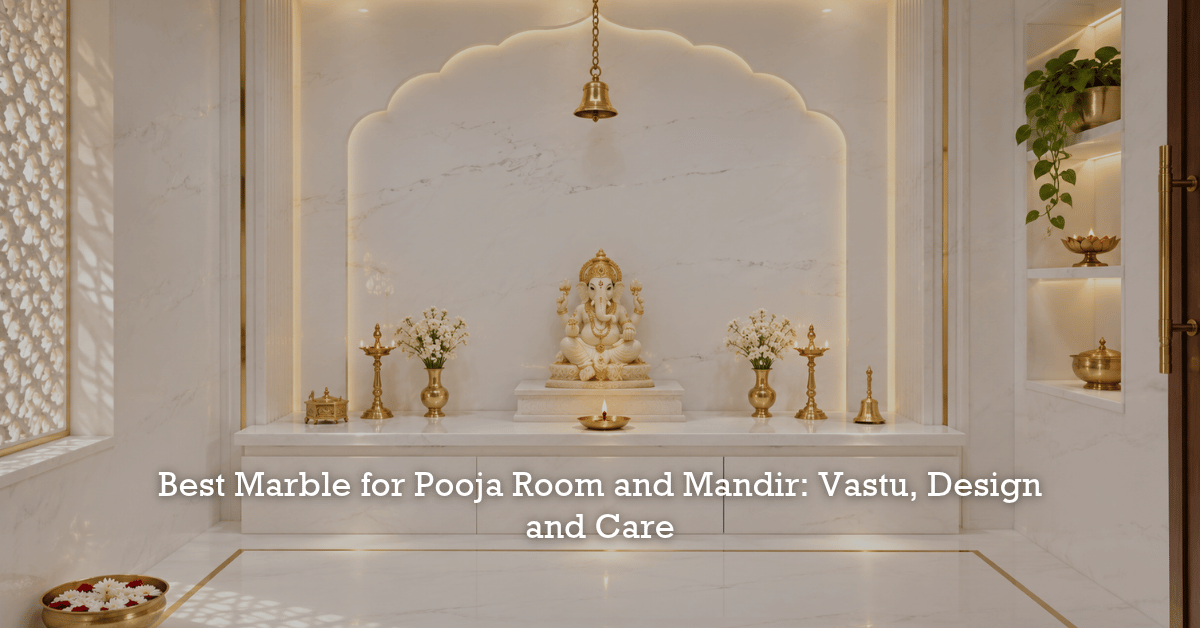
Quick answer: For a pooja room, white Makrana marble is the traditional and still the most practical choice — it is dense, it has centuries of use in Indian places of worship, and the warm white tone suits the room. Vastu places the pooja room in the north-east and recommends white or light-coloured stone. The real decision most people get wrong is not which marble looks best, but which one survives daily ghee, oil, haldi and kumkum without staining.
We have traded stone from Kishangarh since 1978, and the pooja room is the one room where customers ask us the same three questions every single time: which marble, which direction, and why did the last one go yellow. Here are the answers.
What Vastu Says About the Pooja Room

Treat this as traditional guidance, not engineering. It is widely followed in Indian homes and worth knowing before you plan the stone.
Direction. The north-east corner — the Ishan kona — is considered the most auspicious place for a pooja room. If the north-east is not available, east is the next choice, followed by north. South-facing is generally advised against.
Where the idol sits. The idol is usually placed against the north-east part of the room, on a raised platform rather than directly on the floor, facing east or west. The person praying then faces the opposite way.
Colour. Vastu guidance consistently recommends white, light yellow and light blue for a pooja room, which it associates with purity and calm. This is exactly why white marble became the default — the material matched the prescription.
Where not to put it. Common advice is to avoid placing a pooja room under a staircase, against or adjoining a toilet wall, or inside a bathroom.
That colour guidance is the part that matters for your stone decision. A white or near-white marble is both the traditional answer and the practical one.
Why Marble Became the Traditional Choice
This is not only sentiment. Makrana marble, quarried in Rajasthan, carries Global Heritage Stone Resource status from the International Union of Geological Sciences — a designation given to stones with proven historic use and durability. The list of buildings it was used in includes the Taj Mahal, the Victoria Memorial, Humayun’s Tomb, Akbar’s Tomb at Sikandra, the Dukhnivaran Sahib Gurdwara in Ludhiana, the Moti Masjid in Lahore and the Sheikh Zayed Mosque in Abu Dhabi.
The point for a pooja room is simple: this stone has sat in places of worship through centuries of oil lamps, smoke and daily washing, and it is still standing. That track record is the argument for marble, not the showroom shine.
If you want the full breakdown of grades and current rates, our Makrana marble buying guide covers every variety with indicative prices.
Which Marble Suits a Pooja Room

| Stone | Character | Why it works here | Watch out for |
|---|---|---|---|
| Makrana (Dungri / Albeta) | Dense warm white, fine grain | The traditional choice. Hard, low-porosity, ages well. Carving grade available for jaali and pillars | Warm white, not bright white. Genuine Makrana needs verification |
| Statuario | Bright white, bold grey veining | Dramatic for a feature mandir wall | Veining competes with the idol. Premium price |
| Vietnamese Crystal White | Clean white, very little movement | Calm, uniform, works beautifully backlit | Softer than Makrana. Seal properly |
| Namibia White | Crystalline white, soft grey veins, dolomitic | Harder than most calcite whites, very uniform | Slight grey cast, not a pure white |
| Onyx | Translucent, glows when backlit | Spectacular for a backlit mandir backdrop | Delicate and expensive. Backdrop only, never flooring |
| Botticino / beige | Warm cream, fine veining | Suits wood-heavy traditional interiors | Not a white — check it against your scheme first |
Our straight recommendation: Makrana for the floor and the mandir body, and if you want drama, one backlit onyx or Statuario panel behind the idol. That combination gives you durability where it is used and beauty where it is seen.
For the stones above, see Crystal White, Namibia White and our onyx collection guide. The wider white marble range has everything in one place.
Marble or Granite for a Pooja Room?

Both get used, and they fail differently.
Granite is harder and does not etch from acids. It resists ghee and oil better than marble does. But granite is usually dark and speckled, which sits awkwardly against the light, calm palette Vastu recommends, and it does not carve the way marble does.
Marble matches the tradition, the colour guidance and the carving. It is softer and it can etch and stain, which is a real cost you plan around rather than ignore.
Our view: for a pooja room, marble, with the care routine below. Granite makes more sense for a utility area or a dark modern scheme where the look is the priority over tradition. If you want the broader material comparison, read how to choose the right marble slab.
Marble Mandir Design: The Four Formats
Most people search for mandir designs when what they actually need to decide is the format, because that determines how much stone you buy and how it is cut.
1. Wall-mounted marble mandir

A cantilevered or bracket-supported shelf with a carved or plain backdrop panel. Best for apartments and small homes. Uses the least material. The backdrop panel is where you spend on a feature stone.
2. Floor-standing mandir unit.

A full structure with a base platform, side panels, pillars and often a carved dome or shikhara. This is what people picture when they say “marble mandir”. Needs carving-grade stone and a craftsman, not just a slab supplier.
3. Full pooja room cladding.

Floor, walls and ceiling in marble, with the idol platform built in. The most expensive and the most striking. This is where a single lot across the whole room matters most — see the lot note below.
4. Backlit panel mandir.

A modern approach: a plain marble or onyx backdrop lit from behind, with a simple platform. Translucent onyx or a thin white marble glows. This is the fastest-growing style in premium homes.
Whichever you pick, match the stone across the whole room from one lot. Marble tone shifts between lots, and in a small room a tonal line between the floor and the mandir base is impossible to miss. Our guide on how much marble you actually need covers lot planning and wastage.
Pooja Room Flooring

Three practical decisions.
Finish. Use honed, not polished, on a pooja room floor. Polished marble becomes genuinely slippery when water from abhishek, washing or bare wet feet lands on it, and a pooja room sees all three. Honed also hides etch marks far better. Read honed vs polished before you commit.
Thickness. Standard 18–20 mm for the floor. The idol platform can be thicker for a solid appearance.
Layout. In a small pooja room, large-format slabs with the fewest joints look calmer and are easier to clean. Grout lines trap oil and ash, and in this room that matters more than in any other.
The Staining Problem Nobody Warns You About
This is the section we wish every pooja room customer read first. Daily worship puts five things on the stone, and each behaves differently.
Ghee, oil and diya spillage — the worst offender. Oil and fat stains behave unlike anything else on marble. The pigment sits on the surface, but the oil soaks into the stone and darkens it from within. Ordinary washing will not lift it. Conservation guidance is explicit that abrasive cleaning does not reach the oil and only damages the surface, and that steam cleaning makes it worse — the heat thins the oil and drives it deeper. The correct treatment is a poultice: an absorbent paste left on the stain under cover for around 48 hours to draw the oil back out.
Haldi and kumkum. Strong pigment stains. They need to be lifted quickly, before the colour settles into the pores.
Panchamrit and curd. This one surprises people. Curd contains lactic acid, and marble is calcium carbonate — acid dulls the surface wherever it sits. That is etching, not staining: a dull patch, not a coloured one, and no amount of cleaning removes it. It has to be re-polished out.
Agarbatti and dhoop. Years of smoke deposits soot on walls and ceiling above the mandir. This is why ceiling and upper wall cladding in a pooja room needs periodic cleaning that the floor does not.
Water rings. Standing water from a kalash or lota leaves rings on an unsealed surface.
What actually prevents all of this:
- Seal the stone at installation, and reseal periodically. This is the single highest-value step and most installers skip it unless you insist
- Put a metal or wooden tray under every diya — one tray prevents more damage than any cleaner fixes
- Wipe spills immediately, not after the puja
- Use a pH-neutral stone cleaner only. Most Indian floor cleaners are acidic and made for ceramic tiles — they will dull marble over time
- Never use vinegar, lemon or acid on this floor
- Keep a soft dry cloth in the room so wiping is a reflex
For stains that have already set, our guide on removing stains from marble walks through the methods.
Planning and Buying
See full slabs, not tiles. A pooja room is small and viewed closely every day. Vein and tone variation you would never notice on a hall floor becomes obvious here.
Buy the full requirement in one go. Floor, platform, cladding and skirting from the same lot. Topping up later almost never matches.
Confirm carving grade separately. If your design has jaali, pillars or a dome, the stone needs to be carving grade — that is a different selection from flooring grade, and your craftsman should see the slab before it is cut.
Get thickness and finish in writing on the invoice.
Every slab we despatch goes through our MAS inspection process before it leaves the yard, and we send lot photographs before despatch.
Choosing Your Pooja Room Marble
Come and see the slabs side by side. Photographs cannot show how a white reads under warm diya light versus daylight, and that difference decides the room.
📍 Bhutra Marble — KH No. 228/194, Makrana Road, Khatoli, Kishangarh, Rajasthan 305801 📞 +91 90011 56068 · ✉️ info@bhutrastones.com
Browse white marble → · Request a quote →
650+ varieties in stock, full-slab viewing at the Kishangarh showroom, live video selection if you cannot travel, and crated insured despatch across India. Planning a visit? Read the Kishangarh white marble guide first.
Frequently asked questions (FAQ's) :-
White Makrana marble is the traditional and most practical choice. It is dense, low in porosity and has centuries of use in Indian places of worship. For a feature backdrop behind the idol, backlit onyx or Statuario works well, with Makrana used for the floor and mandir body.
The north-east corner, the Ishan kona, is considered most auspicious. East is the next preference, then north. South-facing is generally advised against, and a pooja room is usually kept away from staircases and toilet walls.
Vastu guidance recommends white and light colours such as light yellow and light blue for a pooja room, which it links to purity and calm. White marble is the usual way that guidance is applied.
Marble suits the pooja room better because it matches the light colour palette Vastu recommends and it can be carved. Granite is harder and resists etching, but it is usually dark and speckled and does not carve the same way. Marble needs sealing and prompt wiping to handle ghee and oil.
Yes, and it is the hardest stain to deal with. Oil soaks into the stone and darkens it from within, so surface washing will not remove it. The treatment is an absorbent poultice left on for around 48 hours. Prevention is far easier: seal the stone, keep a tray under every diya and wipe spills immediately.
Honed. A pooja room regularly gets water from abhishek and washing, and polished marble becomes slippery when wet. Honed also hides etch marks from curd, panchamrit and other acidic offerings much better.
Yes. Statuario and other white Italian marbles are used for mandir backdrops and feature walls. They are softer and more expensive than Makrana, so a common approach is Makrana for the floor and platform with an Italian or onyx panel behind the idol.
Standard flooring thickness of 18 to 20 mm. The idol platform is often made thicker so the edge reads solid.
Bhutra Marble has supplied natural stone from Kishangarh, Rajasthan since 1978 — 650+ varieties, full-slab viewing at our facility, and pan-India dispatch. To view genuine Italian Statuario lots and get a fair, direct rate for delivery anywhere in India, get in touch.